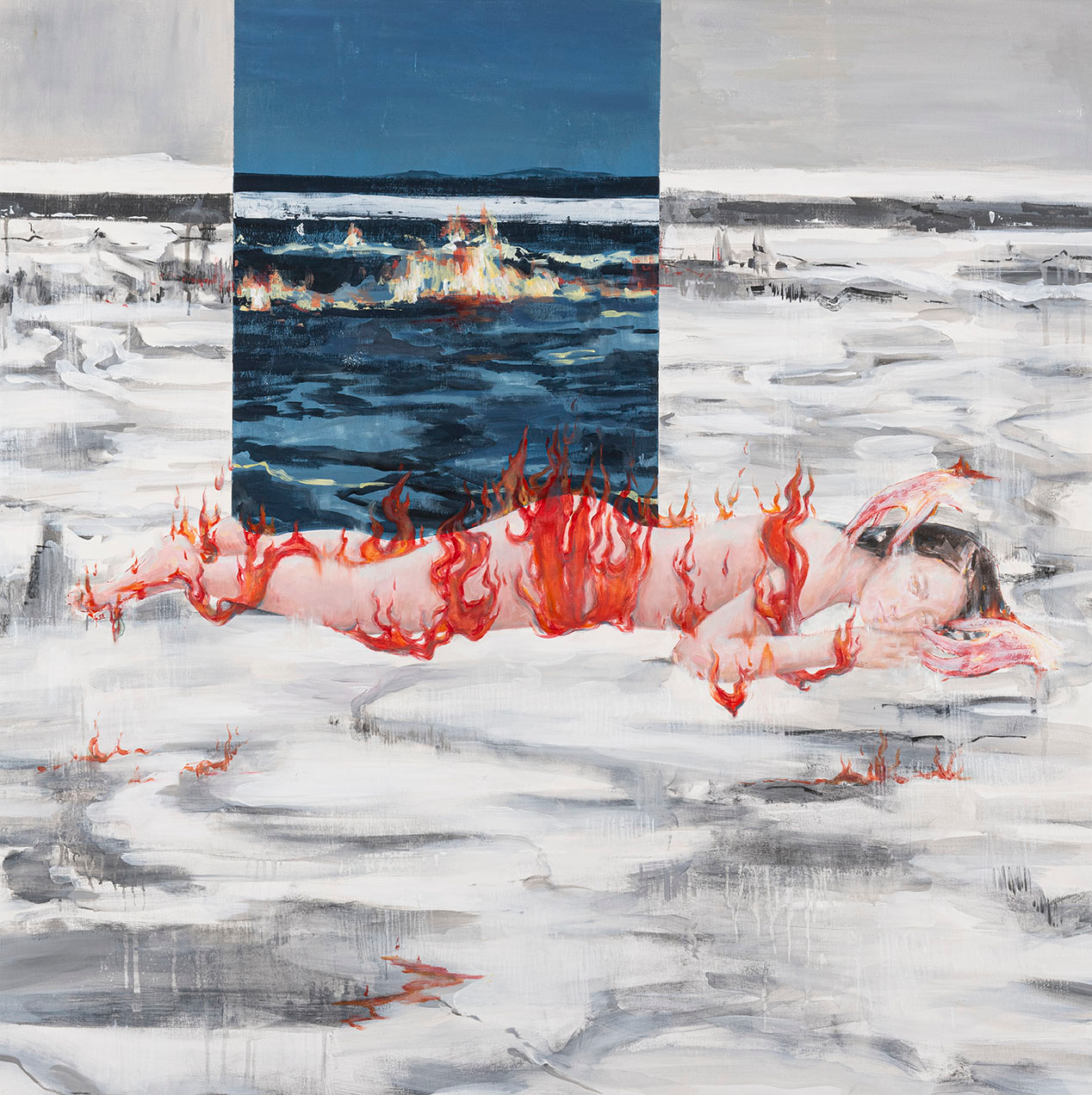
Egyptian painter Aya Gamil (b. 1996) speaks to bayn/space about her most recent body of work she presented in a solo show entitled Ravelled at Gallery Misr in Cairo in December 2025.
In Gamil’s paintings, the body is not a fixed form but a shifting field that carries what remains from lived experience. The body appears, dissolves, and reforms—almost as if the memory is shaping the image while unshaping it the same time.

You studied at the Faculty of Fine Arts in Helwan, Cairo. Could you tell us more about your path of becoming a visual artist?
Aya Gamil: My relationship with art started through my sister who was an art student. I was mostly observing, fascinated by how she could create something out of nothing—an experience that shaped my understanding of art from a very early age.
Observing her led me to join the Faculty of Fine Arts in Helwan. While I was doing well academically, my focus remained on my connection to the work itself.
Early on, I began making paintings for myself, not as assignments, but as something personal. That’s when my practice truly began.
You consider the body as a vessel of memory. Could you elaborate more on this thesis?
Aya Gamil: I do not see memory as something fixed in the past, it is ongoing and constantly shaping us.
The body is where this becomes visible. It carries personal and collective traces, and is continuously shaped by experience.
The depiction of bodies plays a central role in your practice. Could you tell us more about your interest towards painting the corporeal?
Aya Gamil: I’m drawn to the body because it can reveal what is not easily visible.
Through it, I engage with memory, change, and emotion without explaining them directly. Meaning emerges without being fully defined.

Particularly in your more recent work the notion of understanding the body as a shifting, evolving entity carrying our past through various lived experiences. Visually you translate this by presenting multiple scenes within your paintings. How do you view the relationship between memories and painting?
Aya Gamil: My process begins with writing. I keep visual diaries where I document thoughts, personal experiences, and what I observe around me.
Painting becomes a translation of these fragments, bringing together personal and collective traces rather than a single narrative.
At a more conceptual level, what drives your interest in depicting memories?
Aya Gamil: Memory, for me, is a way of understanding experience.
It is unstable, it doesn’t return as it was. Each time it is recalled, it shifts and is reshaped depending on the present.
What interests me is the distance between what happened and how it continues to exist and transform.

In this body of work we also predominantly see nude bodies. Could you discuss this in more detail? Is there a particular reason for this, for example a symbolic one?
Aya Gamil: I use the nude body to reduce imposed context.
Clothing places the body within specific identities or social positions. Without it, the body becomes more open and less defined.
I am interested in the body in its direct, unconstructed state. Any intervention must be intentional and meaningful.
I also see the body as connected to the world, and the world existing within it.
The compositional doubling is also present in this body of work. What do you aim to establish through repetition? Is it a vehicle to ‘remembering’?
Aya Gamil: Repetition in my work extends beyond the body to forms and experiences.
The same element may appear more than once, but each time differently. It is not repetition as sameness, but as change, showing how perception shifts over time.

The motifs of water and tigers also appear in this body of work. What are their meanings?
Aya Gamil: Water reflects memory in my work.
Its fluidity, how it dissolves, shifts, and reforms, mirrors how memory behaves. It is constantly shaped and reshaped, never fixed.
The tiger, on the contrary, appeared in my work during a moment of instability in my practice. I was drawn to its solitary nature, but it gradually became a dominant presence, repeating across the paintings.
In some works, I visualised it emerging from my head and moving through the space, reflecting how it occupied my thoughts.
This made me realise that the process is not always controlled, sometimes the work starts to guide its own development. Eventually, the tiger faded, marking a shift in my understanding that painting cannot always be controlled and must sometimes be allowed to develop on its own.

See Aya Gamil’s website here and follow her on Instagram here.