Tunisian artist Ameni Abida (b. 1997), who grew up around the world, discusses her practice in relation to Ghorba, an overarching theme in her work, denoting alienation, homesickness, and a sense of estrangement experienced when living far from the homeland.
You hold a BA in Culture and Politics from Georgetown University and an MA in Museum and Gallery Practice from University College London. Currently, you are pursuing an MFA degree at NYU Abu Dhabi. Could you tell us more about your path of becoming an artist?
Ameni Abida: I’ve had this little ‘bug’ since I was about eight years old. At the time, I had a neighbour who was my age. We used to go out every day after school and play. She sadly passed away with her mother in an accident that same year. Not knowing how to grieve, I spent a lot of time avoiding the world by watching TV. My mom was concerned and decided to take me to our neighbour’s house. She was regularly checking on my friend’s sisters since her passing. My mom asked the eldest if she could teach me how to paint. She was a great painter. She painted these beautiful, large hyperrealist paintings of flowers, and I could not believe talent like that existed. Mom told her about my TV addiction, and the artist said, ‘I’ll be your TV’. She brought me papers and watercolours, and I began to paint flowers in a vase, unsure of what else to do. Painting became my escape ever since. I wanted to attend art school after high school, but I ended up being waitlisted. I settled for Culture and Politics because I was very much invested in the politics at home, and then while studying, I quickly realised I had more affinity for the cultural theory aspect than the political science part. Museum studies felt like a natural bridge to the art world, which I slowly craved getting into, but knew that with my lack of art credentials, it would be difficult. I picked up painting seriously again after my master’s, and really developed my practice when I started to work. Wherever I lived, my apartment became my studio, and I became a museum practitioner by day and an artist by night.

How do you think your ‘Third Culture Kid’ background is present in your work? You grew up between Nigeria, Libya, Saudi Arabia, among other places.
Ameni Abida: We did move around a lot when I was growing up. Because we moved quite a bit, I recognised that stability was the return flights home. Otherwise, you really feel rootless. There is a type of longing you develop for an identity, for a place to call home. And the funny thing about it is that, once you go home, you also don’t really feel completely at home, because you recognise you don’t fit in quite as much as you would like. And you are yourself reminded of how different you are from everyone else. My aunt used to call me the “stranger’, a distant cousin once said my accent wasn’t a ‘100% tounsi’. There is also the realisation that my perception of home, as the ‘outsider’, is a little different from those who stayed. There’s a lot of romanticisation on my end, as I’m trying to nostalgically restore or reflect on what I know and remember. I think all of these things are ‘Third Culture Kid’ realities. Not feeling like you truly belong anywhere, missing all the homes, trying to hold on to some form of identity as you move.
While the idea of home has been constantly present in your work, how do you reflect on the changing themes within your practice?
Ameni Abida: One overarching theme in my practice is Ghorba, which means the alienation, homesickness, and sense of estrangement experienced when living far from the homeland. This theme naturally encompasses others such as memory, displacement, nostalgia, and belonging. My understanding of Ghorba oscillates between my personal experience and a broader conceptual framework through which I explore home, identity, migration, and longing. These themes first started with me reflecting on my trips back home in Tunisia, and thinking about how my visits were profoundly affecting me every time. I realise that the moments I spend with my family or in my hometown are very short, and with each year passing, there is more and more absence. That very fact made me want to document our home and our rituals as much as possible, before things irreversibly change. As my work has developed, Ghorba has become less about physical distance alone and more about physical and temporal dislocation, like, for example, how estrangement is experienced both abroad and at home, or how memory itself becomes fragmented and unreliable. This evolution has also led me to engage more critically with themes of postcolonial identity, diaspora, and the in-between state of living across cultures. I am increasingly interested in how nostalgia can be both comforting and painful, functioning as a way to preserve intimacy while also emphasising loss.
Your beloved Tunisia also plays an important role in your oeuvre. How would you characterise your relationship to your home country vis-à-vis your artistic practice? Do you ever fear your image is ‘too’ nostalgic?
Ameni Abida: Tunisia is a terribly beautiful land with incredible light. I can confidently say this isn’t my bias speaking, because in art history, artists Paul Klee and August Macke have said it themselves that the North African light has a different type of clarity. I think it is because of the way the land is placed between sea, desert and mountain. Some would say California is the same. So this land is special to me, firstly because of its atmospheric quality. The sky, on its good days, is very blue, and the sunrises and sunsets are always my favorite things to watch. And then there are our customs, which are so rich and symbolic, carrying different cultures and heritages from millennia. So yes, you can fall into a lot of nostalgic/romantic imagery, and there is reason for it because there is a lot of romance to experience. However, there is always something that clashes with Tunisia’s reality. The sky used to be a lot bluer in the summers, but it has slowly turned whiter over the years due to increasing humidity from global warming. The country’s political and economic realities have also become harsher. Colonialism is of course to blame for starting the reality that we know today, and colonial tourist imagery is to credit for a lot of the romanticism that characterizes the country. We can look back and say ‘oh, times were simpler/ nicer then’, but the fact of the matter is that we have known oppression far before our grandparents’ time. So we would be inherently nostalgic for a time that technically does not exist. But I think that very idea is interesting. Also, did you know that Tunisia is apparently ruled in astrology by Pisces? I think that somehow the country’s essence is nostalgic.

Questions related to identity and belonging occupy a central stage in your work. How do you combine the personal and societal in your work?
Ameni Abida: I look at my personal experiences and try to expand them. My experiences are not unique. I may use specific references for works, but the overall experience is certainly not just mine. If I create something that stems from a personal instance, I know for a fact that there will be someone who will resonate with it, that it is a part of a larger phenomenon, and that it belongs to a specific social explanation. I will give the example of my sea paintings. I swim in the sea almost every day in the summer. I know it so intimately. I also know that this very sea carries so much in it; it is a graveyard for those trying to cross, it is an ever-changing body due to global warming, and it destroys as much as it brings peace. It has known wars, colonial hydrotherapy, leisure, and death. By working from something so familiar to me, I am able to touch on histories and realities that go far beyond my own life. What starts as something private opens onto larger questions of displacement, violence, climate, and movement. I think this is how I combine the personal and the societal: by trusting that intimacy can carry weight, and that individual experience can act as a lens through which broader social and historical narratives become visible.
In your new series “Henna Nights” you revisit Tunisian pre-wedding rituals. Could you tell us more about these five works?
Ameni Abida: I made them thinking about Tunisian weddings and their symbolisms. As mentioned earlier, Tunisian culture is comprised of elements from different civilisations and cultures such as the Phoenicians, the Amazigh, the Punic, among others. Weddings and the rituals surrounding them are a perfect example of how these cultures intermix. This series specifically focused on the ritual of wearing henna, which is one of my favorite parts of weddings. The women gather together around the bride, they sing, dance, have their hands adorned with henna or harqous, they sometimes wear the most beautiful traditional outfits such as the lebsa hammamia. It’s one of the only time in the year where you can immerse yourself in tradition, literally by adorning yourself with these clothes that rarely come out otherwise. And I think this is really important to me, because weddings are one of the only occasions where we actually gather to practice or remember the specificities of our culture passed down from our ancestors. And I think I love the henna party even more because of its intimacy. It is a ritual that is filled with so much care and joy. There is a sense of preparation, but also of transmission, of women passing things down to each other without needing to explain anything.

You moved back to Abu Dhabi to pursue a new degree. How does it feel to be at an art school? How would you dissect your experience so far?
Ameni Abida: I think it is one of the best decisions I have ever made, and probably one of the most difficult ones too. Pursuing an MFA during this unstable time is kind of crazy. But when I did make the choice, it was because I knew that if I did not pursue one now, it might be harder for me later. Art school is interesting because, on one hand, you are constantly exposed to so many new techniques, ideas, and opportunities, and on the other hand, with all this exposure to newness, you start to feel kind of lost. One of my professors once said, ‘Don’t forget your spine when you are here’. And I think sometimes I forget my spine, because I want to experience everything and make the most out of my experience. There is also a lot of performance, which I think is my least favourite part. You have to know what you are talking about at all times and continuously justify what you are doing, which is a difficult task to do when your process is on the intuitive side. I think practicing takes a lot of reflection, and reflection needs digestion, and in a fast-paced master’s programme, that might be a difficult thing to do. But I think that’s a part of the challenge. You’re exposed to so many interesting people that you can learn from, you get a lot of valuable feedback, and I do think that art school can make you a better artist, if you keep an open mind while staying true to yourself.
What are you looking forward to in 2026?
Ameni Abida: I cannot wait for summer. And I cannot wait to go back home. I am invited to five weddings this year. I am looking forward to my long hours of painting and just making and learning as many things as I can. I have a few project ideas in mind, and I am very excited to pursue them. I do not have that many expectations for 2026. I just want to enjoy the program, my family’s company, and this journey as a whole.

Considering that a great deal of your work relates to identity and the notions of belonging, where’s your home?
Ameni Abida: Home is where the people I love are. My first answer would be to say it’s Hammamet, and it still is. As a location, it is the place that feels the most like home. But in terms of feeling, it could be literally anywhere. Because even when I am in Hammamet, I will still be longing for my friends and versions of myself that I know abroad. I do not think I would enjoy Hammamet as much as I do if I were not surrounded by family there. I have accepted that home will be divided between many places, and that I will belong a little bit everywhere. As long as I can take off my shoes and wifi connects automatically, it would be home.
Could you recall a few moments when you felt particularly at home?
Ameni Abida: Recently, I went to Doha just for a day. When I landed, I took the metro to Msheireb and had coffee with a friend, visited another in Lusail, a friend living nearby picked me up, and we went to lunch in West Bay, and then I walked in my old neighbourhood to visit another friend. I felt so much at home. I lived in Doha for 10 years, and these people that I saw, they are really my chosen family. I grew up with them, spent most of my 20s with them, and really became who I am because of them. They make my nervous system rest just from looking at them.
And then less than 24 hours later, I took a flight to Tunisia and found myself back in Nabeul. I was at my grandmother’s house, lying in my favorite corner under an ethnic blanket, waiting for the Arabic coffee to brew. The nervous system was resting again, because that felt very much like home, too.

Do you have any advice to others who struggle with the idea of home?
Ameni Abida: Everything is temporary, including the idea you have of home. Home can represent something very specific to you one day, and then a few years later, you might realise reality no longer aligns with what you thought of home. I think home has always had an association with permanence, but in this day and age with the rise of ecological disaster and facism, the permanence is not guarenteed. The floods in Nabeul a few weeks ago reminded me of that. And even without regarding all of that, home will always be changing, evolving, and you may think you will live with the same people or places forever, but you will not. So the best you can do is enjoy your time with whoever you live with. Cherish the people around you, nurture them and your space, and make sure you nurture your body above everything else. It is the ultimate home that you have. Decorate and make any space that you have yours, even if it’s a small corner in a room. At home, we either live in the past or the future. Try to appreciate and enjoy the home you have now, as it is. Or if you really don’t feel at home in your home, do that scary thing to move and build it, however you can.
What are your favourite home related rituals?
Ameni Abida: Here is my little list: eating a big bowl of seafood pasta. Watching a movie with my parents. Spending time with my siblings and doing random things. Watching my grandmothers cook. Hearing my grandfather tell the same stories, even if it is for the thousandth time. Staying up late with my cousins and niece. Watching the sunset and sunrise when I can. Watching the sea. Swimming in the sea in the mornings with my family. Walking around the center of the city and having a fricasse. Reading outside when the house is quiet, and the house is napping. Picking jasmine and spreading them around the house. Painting in the late hours of the night. Cooking for the ones I love. Feeding the outdoor cats, petting them, and pretending they are my own.

Follow Ameni Abida on Instagram here. See her limited edition prints with Qaf Editions here.
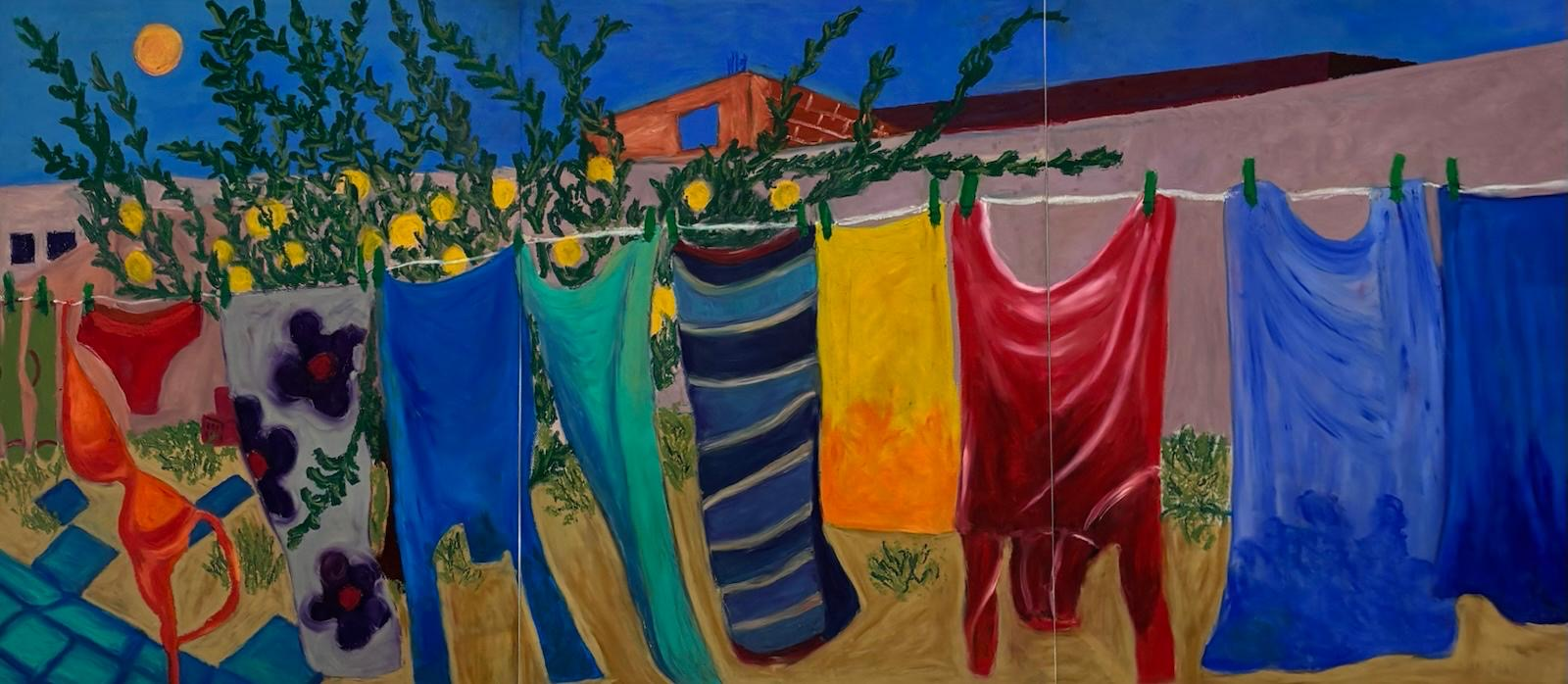
Featured image: Mama Fathia’s Backyard (2026), oil on pastel paper, 42 x 164.7 cm.