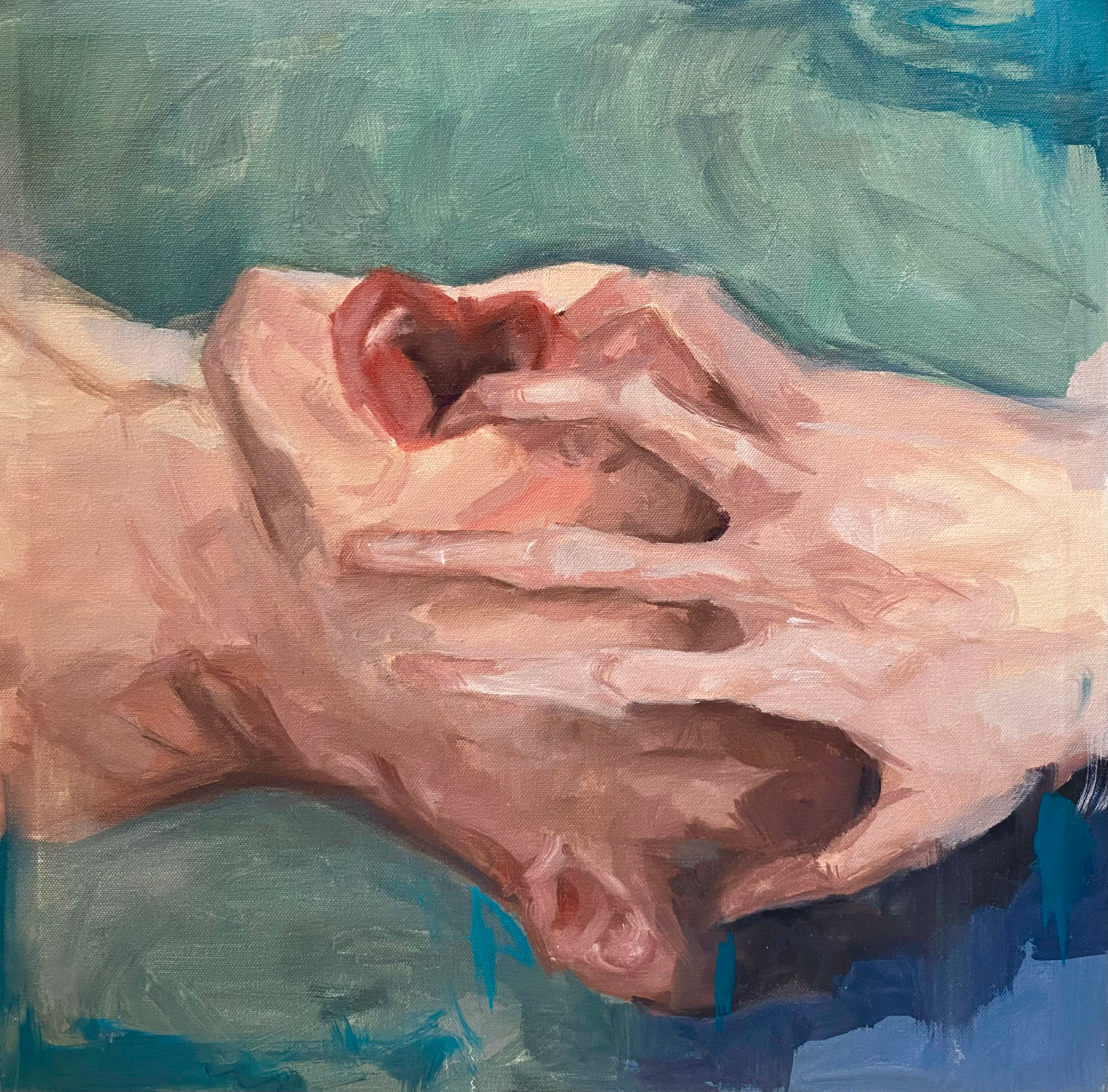
Egyptian painter Amira Khalil often depicts fierce, defiant women who are trapped in societal expectations. Drawing from her personal experiences Khalil speaks to bayn/space about her practice, the visual remnants of attending a school run by nuns, and her interest in historical art movements.

Could you tell us about your educational background? Why did you choose to study fine arts? Was becoming an artist an obvious choice for you?
Amira Khalil: I graduated from the Faculty of Fine Arts from the Painting Department at Helwan University. After high school with a high GPA, I had to choose between pursuing a more stable path in politics or committing to art. I chose to become a fine artist so I could always express myself freely.

What are the main themes you explore in your practice?
Amira Khalil: I aim to share my perspective with the world as an Arab female artist, reflecting on everything happening around me and how it shapes my experience. Through my work, I express what I accept, what I resist, and the struggles I see. I believe we need to view the world more through the eyes of female artists in the Arab world–through art that speaks, takes a stand, and has something meaningful to say. Artists like myself, I think, offer a perspective that is significantly distinct from the male point of view. Ultimately both are, of course, essential to tell a complete story.

You are mainly a figurative painter, known for fierce depictions of women. Why do you think it is so important to paint women?
Amira Khalil: My answer is quite simple. It is important for me to paint women simply because I am a woman, and I do not want others to speak for me. I have the voice, the tools, the techniques, and the courage to express my own experiences as well as those of the women around me who have often been misunderstood and seen only from the outside.
How are we to approach your work; your paintings, are they individual scenes or do they present a more of a continuous storyline?
Amira Khalil: My paintings can be seen as individual scenes, but to me they are all connected in the sense that they are all parts of me. One day, surrounded by war, I create a political piece. Another day, I feel the weight of societal and capitalist expectations placed on me as a young woman, and I paint a woman who screams. It is all interconnected as my work reflects my lived experience.

When looking at your work I often see your characters almost as defiant. Consider, for example, The Scream, Scared Pause, Sinners, or Untitled (2025). Do you recognise this? Or how do you characterise the people you are portraying?
Amira Khalil: I often feel anger towards the expectations placed on how women should speak, behave, and express themselves. In my work, I give them what I feel they are often denied: freedom. The women I portray shout, cry, feel, and desire openly without the fear of being ‘too much’.
In the series of the three paintings titled “Regret” you explore intense poses and depict choreographically complicated scenes. Could you tell us more about these works?
Amira Khalil: This series explores the necessity of allowing yourself to feel deeply, collapse, and confront difficult emotions. It is about letting those moments purify you; reflecting, correcting your mistakes, and eventually forgiving yourself. Change is not always beautiful or poetic; it can be painful and raw. I wanted to paint that reality, resisting the pressure to make everything look or sound aesthetic–that is not the true human experience. I believe in authenticity that comes from the heart and reaches the viewer’s heart, too. As living beings, it is important to create art that people can truly relate to.


Many of your works also contain religious references, for example Faith and Saints. Could you tell us more about these?
Amira Khalil: I grew up in a nuns’ school, and as a child I often wondered why they chose such a life. As I grew older, I found myself doing the same: choosing what aligns with my faith and beliefs. That is when I saw the connection. I find it deeply interesting how religion can shape what a person chooses to do or avoid, and how one can turn away from certain pleasures in devotion to something greater.

You have previously noted your interest in impressionism. What is it about that historical art movement that speaks to you? How do you think contemporary artists can establish a dialogue with a historical movement?
Amira Khalil: I love how impressionism makes you feel something. I also find it really interesting how the brushstrokes and palette carry all the drama and do so much of the emotional work so effortlessly.
Recently, I have also found myself drawn to expressionism. I love the raw emotion, authenticity, and tension in it. As a young artist, studying these movements helps me understand myself better. When I learn about the artists involved in them, I see how everything around them shaped their taste and style. This, in turn, helps me understand why I like what I like.
The reason for this is: You are not just responding to the artwork itself, but to what it expresses emotionally and psychologically. Your taste is being shaped by empathy, personal reflection, and your growing awareness of how life experiences translate into a visual language.

You presented your graduation project at Ubuntu Art Gallery in 2025. How was the feedback on this series?
Amira Khalil: The feedback was both amazing and surprising. It opened up many conversations and discussions which I found very interesting. I was exploring the theme of faith through saints and sinners, and someone told me that, for them, the sinners felt more empathetic than the saints who are usually seen as the ‘good guys’. This made ma pause and think: maybe, at times, people need empathy more than correction. I love this perspective because it changed my point of view too.
As an emerging artist, how would you describe the art scene in Cairo?
Amira Khalil: The scene in Cairo is very diverse, especially among emerging and mid-career artists. So many young artists are actively trying to express new ideas, and there is a wide range of concepts and techniques developing.
At the same time, a part of the scene feels more cautious, often repeating what is considered safe of appealing to collectors. For me, this does not satisfy my need for something new and authentic. Even authenticity can lose its impact when it becomes repetitive over time. Eventually, one can predict what an artist’s next exhibition will look like and that takes away the excitement.

Follow Amira Khalil on Instagram here.