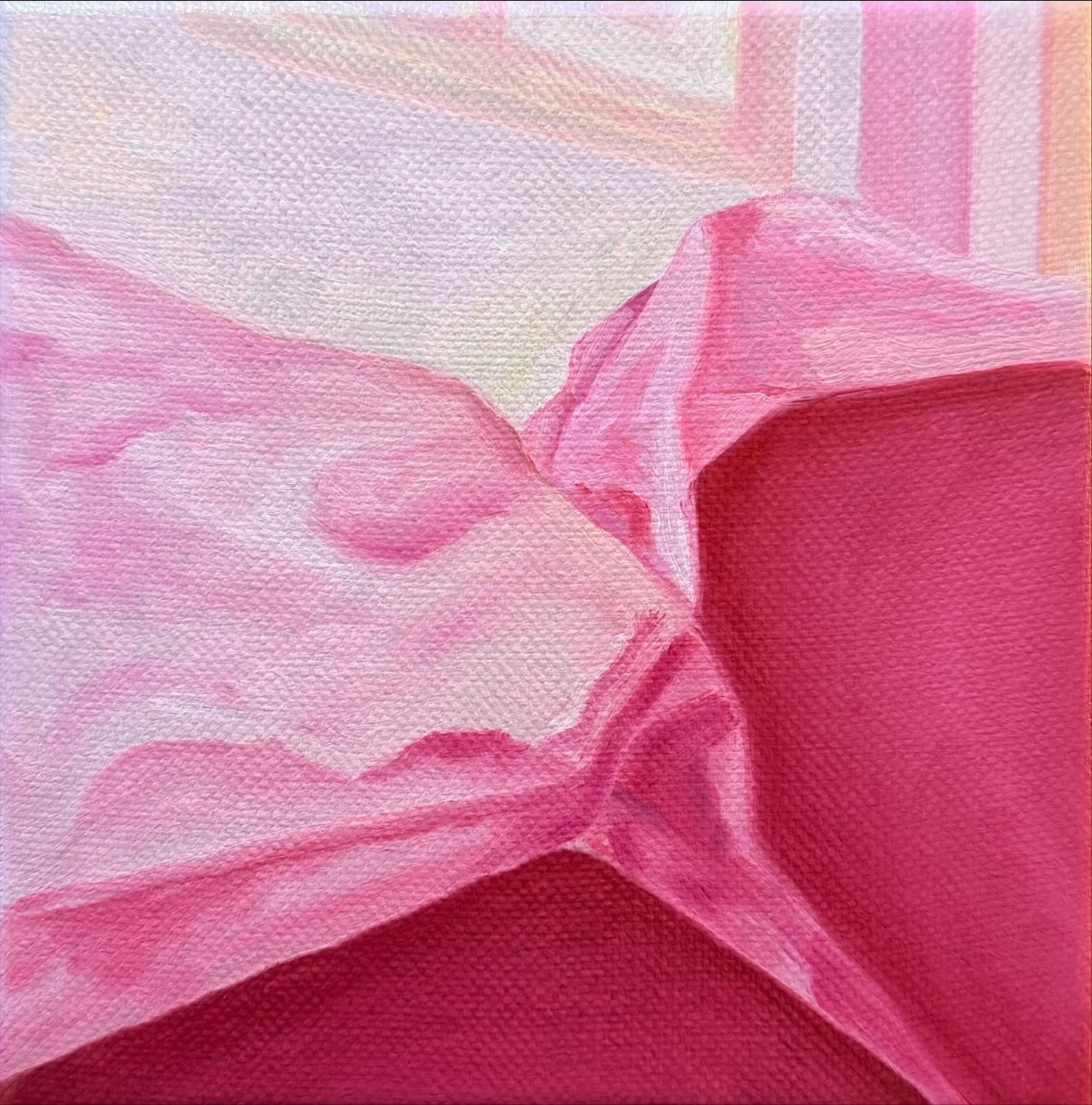
Beirut-based painter Julia Hashem discusses the way she has moved from observing exterior spaces towards a more introspective and self-reflective relationship with the environments she has inhabited. In 2025, Hashem presented All that is quiet, all that is still solo exhibition at Kalim Bechara Art Gallery in Lebanon. In this interview with Elina Sairanen Hashem reflects on her practice and shares her thoughts on the multifaceted and often fragile relationship between lived spaces, intimacy, and identity.

You have a BA in Studio Art from the American University of Beirut and an MFA from the University of Arts London. Could you tell us more about your path of becoming an artist? Was it an obvious choice for you?
Julia Hashem: I think my path was always quite an obvious choice for me. I have been involved in the arts from a young age, beginning violin lessons at six and always painting and drawing throughout my childhood. Around the age of thirteen, my focus shifted more from music toward fine art. Looking back, I realised that music opened up this space of creativity in my life. I still pick up my violin every once in a while. I was also very fortunate that my school in Bahrain was particularly strong in the arts, both music and visual art, which allowed me to begin exploring my practice through GCSE and IB Art.
When I began my BA in Studio Art, it was also the first time I was living in my home country, Lebanon, after having spent my whole life in Bahrain. I think that experience had a significant impact on my growing interest in questions surrounding cultural identity and what home really is. I had struggled prior with my sense of belonging, visiting during summers, I felt like an outsider struggling to articulate myself properly in what was supposed to be my mother tongue. Lebanon became my home during my BA, but this came with more questions; the country seemed to be in a constant state of instability. Later, during my Master’s Degree in London, those questions became even more present. I was making work far from Lebanon while a war had begun there, which led me to reflect more deeply on my relationship to place, memory, and identity. Once again, I was left questioning what it meant to come from a place that faced continuous instability.

You have noted before that your painting is informed by photography. Could you tell us more about the relationship between painting and photography in your work?
Julia Hashem: For me, photography has become a way of capturing moments from my day-to-day life that later inform my paintings. Growing up in Bahrain, my experience of Lebanon relied heavily on the photographs I would take during the summers I spent there. I think that is why photography became a large part of my process. I always longed to feel more connected to Lebanon and to better understand the place I come from.
Living in London alone was an experience that definitely challenged me and made me stronger, and I will not lie and say I was not constantly homesick. Photography became even more important to my process while I was living in London and returning to Lebanon whenever I could. One evening, while looking out of my window, I noticed a family sitting down to eat together. It reminded me of the routine my own family had growing up, where lunch was a moment we shared every day. After that, I found myself returning to the window at the same time each evening, watching them gather for dinner.
I became drawn to these lit windows at night. Whether someone was there or not, there was something deeply human about them, even in their emptiness. Photography allowed me to hold onto these moments and continue working with them while I was away. So whenever I returned to Lebanon during my Master’s, I felt like I was on a mission to document the scenes my eyes were instinctively drawn to.

Thematically your work explores Lebanese identity through architectural and urban references but there is also a more personal dimension related to the sense of light and space vis-à-vis your experiences from the cities in which you have lived. How has your work evolved thematically over the years and how did you arrive at his point of architecture and urbanism?
Julia Hashem: I have lived in Bahrain, Lebanon, and London, and each place has shaped the way I think about space and architecture. Even growing up in Bahrain, I was drawn to the older architecture in the souq and its juxtaposition with the newer buildings. In these spaces, I became aware of a sense of temporality within the urban fabric, where traces of the past coexist with the present and quietly shape what a place might become in the future. This dialogue between old and new was something I noticed in every city I lived in, each carrying its own distinct identity through its architecture.
I think I only really became conscious of how these environments influenced me once I began reflecting on how each place had shaped my sense of belonging. In my earlier works, there were no explicit implications of human presence. The focus was more on architecture itself and on a somewhat obstructed relationship between the spaces I was observing and my own position within them. The compositions were often very close to windows and tended to be low contrast and almost monochromatic, which created a sense of distance or detachment.
It was only more recently, particularly in my exhibition All That Is Quiet, All That Is Still, that a stronger sense of intimacy began to emerge. After moving back to Lebanon following my Master’s degree, my perspective shifted. The work moved away from a more detached observation of exterior spaces toward a more introspective and self-reflective relationship with the environments I inhabited.

Your previous body of work was concerned with the temporality of buildings and the relationships that they both allow and deny between us as humans. Now in your most recent body of work you look at the inside of these spaces, focusing on the intimacy of domestic spaces through a monochromatic lens. Could you tell us more about this transition?
Julia Hashem: When I moved back to Beirut, I no longer felt like I was ‘in between’ spaces. For the first time in a while, everything around me felt still. That stillness created a strong urge to turn inward, not just to observe the lives of others, but to reflect on my own existence. After working on the Through Your Window series, looking inward became inevitable. How could I keep looking at the existence of others when I had never stopped to consider my own?
I began by examining the spaces that belonged to me: my bedrooms and living rooms across three places; my parents’ house in Bahrain, our living room in Saida in southern Lebanon, and my apartment in Beirut, where I spend most of my time. In several works rooted in my Beirut apartment, it began to feel natural to include fragments of myself, bringing a sense of intimacy into the spaces and contemplating the dialogue between personal memory, domestic life, and the monochromatic lens I was exploring.

Looking at these paintings I was reminded of a similar series by Palestinian artist Rana Samara called Intimate Space. I find it quite intriguing that the insides of a home can feel so private. How do you approach the notion of privacy in you work? Why is it a theme you want to explore?
Julia Hashem: It is always intriguing for me to see the infinite ways the notion of intimate space can be approached. Samara’s work feels so personal and creates a relationship between us and her most private spaces. I return to the domestic space because it sits at an interesting threshold between the private and the visible. When I paint spaces inside my home, I am working with places that are normally experienced very intimately and quietly, rooms, corners, moments of light that only I see. Translating those spaces into paintings inevitably shifts them from something private into something shared.
The paintings become accessible to others, and they even invite others into a space that is not expecting them. The work does not fully reveal the interior of the home, but rather holds onto a certain sense of distance or quietness. The limited palette and stillness of the compositions invite the viewer to pause at the threshold of the space rather than fully enter it.
There is a sense of privacy in a space that is not expecting visitors, the sheets are not done, and the room has not been tidied. Painting these spaces becomes a way of reflecting on how domestic environments hold the memory of my physicality. By focusing on small, intimate moments within the home, I acknowledge a quiet existence, one that attempts to find significance.

For me it’s the absence of people, apart from the protagonist in Too Close, Too Personal and A Little Too Comfortable, that makes these paintings so intensely personal and private. What are your thoughts?
Julia Hashem: I agree. One of the ideas I was exploring throughout the series was the tension between intruding on a space and being invited in, which for me reinforces the privacy and intimacy of the space. During the making of these works, I often wrote personal texts that mostly stayed private, but fragments of them found their way into the titles. For example, Stay for a While invites the viewer into a bed, while Too Close, Too Personal becomes far more private because I have introduced my own body into the space. Placing myself in these spaces added a layer of vulnerability that was new for me, making the work feel especially private (even for me), particularly when they were exhibited. It also marked the beginning of reflecting not just on my spaces and presence within them, but on my identity as a woman inhabiting these spaces.

Could you also elaborate more on the decision to paint the series of (a woman? laying in bed)?
Julia Hashem: The domestic spaces in these paintings were already deeply personal before I introduced the figure in bed. The work demanded me to paint the space through my eyes, and eventually include parts of myself. I started with scenes in bed because it is one of the most private, intimate moments of daily life, an ordinary act that stays consistent no matter the city I am in.
I became obsessed with the traces we leave behind, from the subtle impression our bodies leave in a mattress each morning to the quiet evidence of presence that lingers even when we are gone. These marks feel like a memory that is made physical.
By including myself, I also contemplate the tension between observer and observed; I am both inside the scene and outside of it. Not only do I paint myself, while sitting in that space, but I am also a watcher of my life taking place. My viewer becomes implicated in this act of intimacy, invited to witness without intruding, while I remain present but never fully revealed. It is a negotiation between what is visible and what remains private, one that mirrors the ways we navigate our own intimate lives.

You note that the series relates to acts of self-beholding. How do you understand this term and how did it come about in your work?
Julia Hashem: It began with a heightened awareness of my own being. At first, my attention in these domestic spaces was almost entirely on the objects around me, the couch, the lamp, the curtain. But gradually, my focus shifted to the realisation that these spaces exist in relation to my presence; I could no longer separate myself from them. I became both a subject within the work and an observer of myself inhabiting that space.
For me, self-beholding is both introspective and confrontational. It’s a way of examining my identity while confronting myself within that identity, trying to understand my existence and how it shapes the space I inhabit. I became drawn to the traces I leave behind, the sheets moulded to my legs, the lights that are on, mapping myself into the space.
The figure of the woman in bed was just the beginning of this exploration. It marked the shift from observing spaces as external and neutral to engaging with them as intimately connected to my own body and memory. And although the moments come from daily routine, I find myself almost performing for myself while I document these moments within my work. This act of self-beholding has since expanded, becoming a core theme in my work as I continue to explore the meaning of my presence as a female artist in the space I inhabit.

The monochromatic hues support a sense of stillness and quiet present in this work. How do you negotiate the web between aesthetic and stylistic considerations in relation to thematic ones?
Julia Hashem: Honestly, part of the reason I initially wanted to experiment with a more limited palette was that three of my favourite artists are Hopper, Richter and Rothko. Looking at their colour palettes, I felt that the limited colour palette played such an important role in the feelings that resonated with me, and kept me coming back to their work.
During my MFA in London, my campus neighboured the Tate Britain. So I spent a lot of my time sitting with the artworks, immersing myself in the space, sketching and thinking there and of course, grabbing a warm chai latte and a slice of cake. They had a few smaller Rothko pieces on display, and seeing them in person sparked a deeper desire in me to create this shift in colour in my work. How could something carry so much stillness and yet simultaneously evoke so much emotion every time I looked at it?
I knew I was taking a risk with my palette while I was back in Beirut, monochromatic work has been done before, yes, but I was not seeing much of it during the current time. I did not want to paint using many colours, I did not want to leave definitive lines or heavy brushstrokes either. My palette not only represented a sense of stillness and quietness of everyday life, but I think it somewhat reflects a shift in my own being and the calmness in my character as I go through each day, taking time to notice little things.
The aesthetic choices I make and the thematic choices somewhat go hand in hand; they are constantly in conversation with one another. In part, they are born out of contemplation, and in part, are completely intuitive. To me, the monochromatic palette changes how time functions within the work; it creates a contemplative space that reflects my own observation of the interiors.

What’s next for you? What are you working on at the moment?
Julia Hashem: I have recently made the transition from acrylic to oil, so I have been painting with so much newfound curiosity. It has been rather eye-opening to make this shift and the endless experimentation that oil paint offers, especially the drying time and being able to create monochromatic paintings that are more layered. I have also been creating so many works on paper that are much more spontaneous, alternating between mediums that allow a faster pace, specifically water-soluble crayons and pigment sticks, while the oil paint allows me the time to reflect between each layer.
As for the subject matter of my work, my exploration into the intimate domestic space continues to grow. I have been looking into more spaces around the house, understanding that an important part of my domestic space is actually my studio. My work is becoming more diary-like, documenting the moments of my routine as an artist both through my eyes and from a third-person perspective. The more I paint and sketch, the more I find that the boundaries between my studio and me become increasingly blurred. I become another object in my space. The deeper I dive into my artistic practice, the more questions arise as I discover that even my studio holds a sense of temporality during these once again, uncertain and extremely difficult times. The time I spend painting and drawing is usually time I spend alone. I wonder sometimes to what extent this isolation comes with the practice, my companions being my paintings, and even those companions are only by my side temporarily, as even they have a life of their own.
