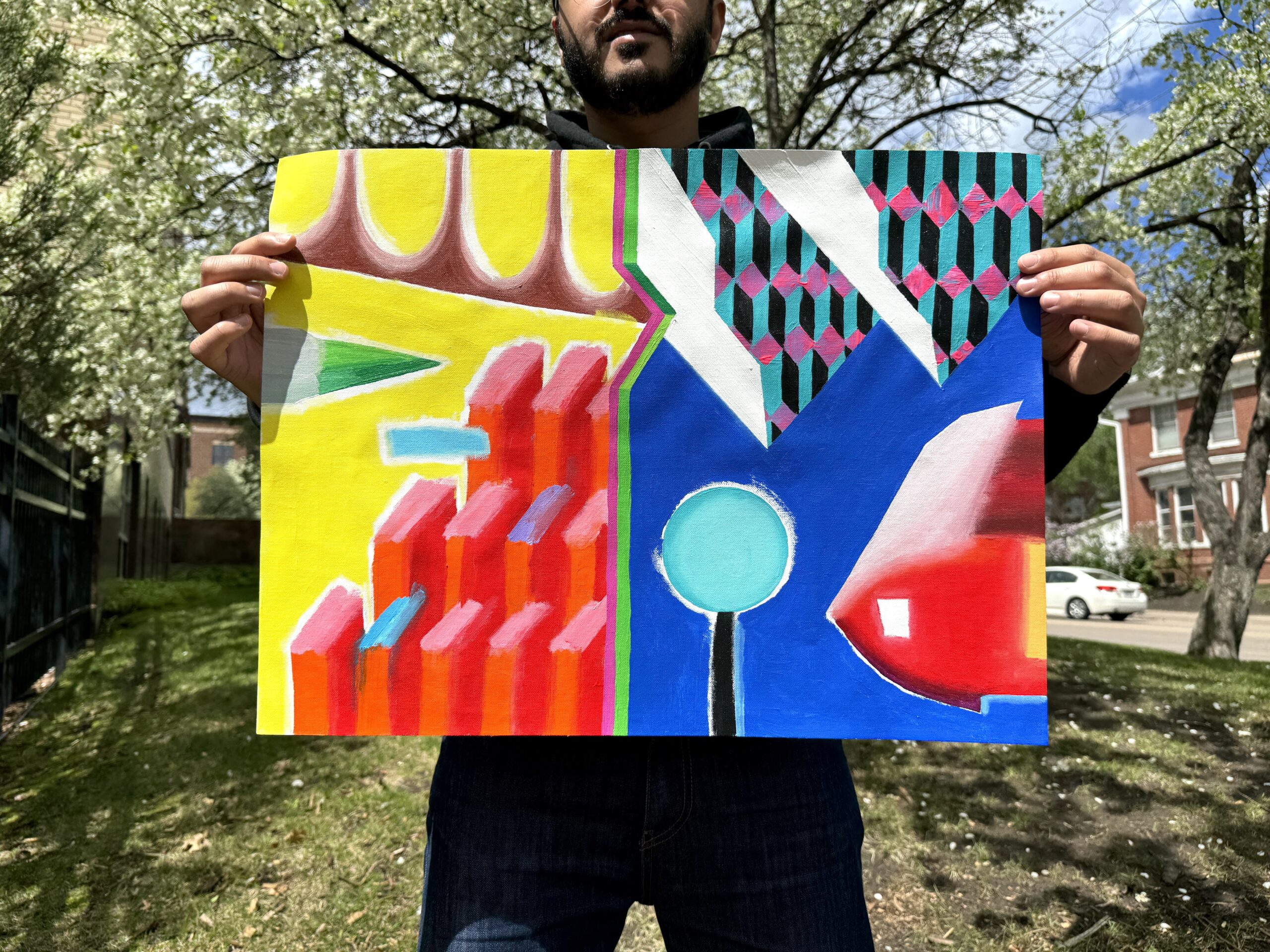
Soon-to-be an MCAD, Minneapolis College of Art and Design, MFA graduate Mubarak Al Thani is known for aesthetically deconstructing urban landscapes. Predominantly exploring architecture, skylines, and infrastructure he speaks to bayn/space about his decision to pursue an MFA and reflects on the cornerstones of his practice.

Could you tell us more about your path of becoming an artist? Was it an obvious career choice for you?
Mubarak Al Thani: It was not an obvious choice but something that happened over time. During my schooling, I just simply started to draw. And that is what I did: I just drew. On notebooks, on random pieces of paper, everywhere really. I think one significant moment was when I bought a canvas but it took me two or three years to actually paint on it because I found it so serious. Since 2010 I have engaged in visual arts on a continuous basis.
You are currently completing an MFA programme at the Minneapolis College of Arts and Design (MCAD). Why did you choose to pursue an MFA programme at this stage of your life? How has the experience been so far?
Mubarak Al Thani: I just defended my thesis so I will graduate in less than two weeks in May 2026! Before pursuing an MFA I felt that I was stagnating in relation to my practice. I applied for a number of programmes because I wanted to be self-critical of my practice and to keep it moving, so to say. I am so happy I chose MCAD, the school was such a perfect fit for me and it really fit like a glove.

You also hold a BA in Politics from Georgetown University and an MA in Urban Planning from NYU. How has your academic background influenced your artistic practice?
Mubarak Al Thani: Indeed, my background is in international politics, cultural studies and urban planning. During my MA I also did a minor in architecture. All of these disciplines inform my artistic practice and present a starting point for my instigations. In a way they are all ‘guidelines’ to my artistic work. At the same time, this is all subconscious. When I walk around a town, for example, and I play attention to a beautiful arch or whatever else, I do not necessarily analyse it from a critical, urban planning perspective, but it is just something I take note of and then it appears somehow and somewhere in my artistic practice again.
In your work you attempt to deconstruct landscapes and explore the relationship between reconfigured elements through shapes, forms, and colours. How has your practice developed over the years?
Mubarak Al Thani: Deconstructing and reconfiguring helps me to re-imagine a world and to create a landscape that is mine.

Your interest in architecture, landscaping and cityscapes is visible in your work–arguably echoing your academic and professional interest in urban planning and design. Why are you drawn to portraying the environment we live in?
Mubarak Al Thani: For me it is quite simple. It really just comes down to the fact that I am inspired by so many things that I see in my surroundings. At the same time, I have a habit of drawing all the time. Put me in any coffee shop and eventually I will draw it. That also means that I am very conscious of my surroundings and all of this manifests in my paintings and sculptures. Now that I think about this, there is a certain archival quality to my work–the practice translates into one large visual repository or archive in relation to what I have seen and where I have lived.

Your work combines both abstraction and representational elements. In the series “Aerial Views”, for example, your approach is more abstracted whereas in some of the city series such as Midwestern Potato Salad (2024), Deep Fried City (2024), or Music and Boots City (2023) there are more representational elements. How do you choose what to portray? And what is it about urban spaces, our neighbourhoods and cities that attracts you?
Mubarak Al Thani: Yes precisely, I combine the two and I often feel the need to create a ‘break’ in my works. What I mean by that is an urge to not be orthodox or strict with myself but to offer something unexpected–either a break from abstraction or a break from representation. Often these ‘trigger points’ become anchors through which I guide the viewer or remind the viewer of the bigger picture I am creating. I guess this comes down to wanting to break the rules and I do this by combining the both.
For my attraction to urban spaces and our neighbourhoods, it comes down to space and time. It is also nostalgia and memories, traces of lived experiences.


Aesthetically your work is colourful, vibrant and bright. Could you tell us more about the development of your prevailing aesthetics?
Mubarak Al Thani: Aesthetically over the years I have become more strategic with colour choices. Nowadays I choose carefully the moments I go crazy and bold and when I restrict myself more. This is because I have developed a better understanding of how colours interact.
What are you working on right now?
Mubarak Al Thani: Currently I am reconstructing and reconfiguring the Qatari architectural landscapes.

See Mubarak Al Thani’s website here and follow him on Instagram here.
You might also like: