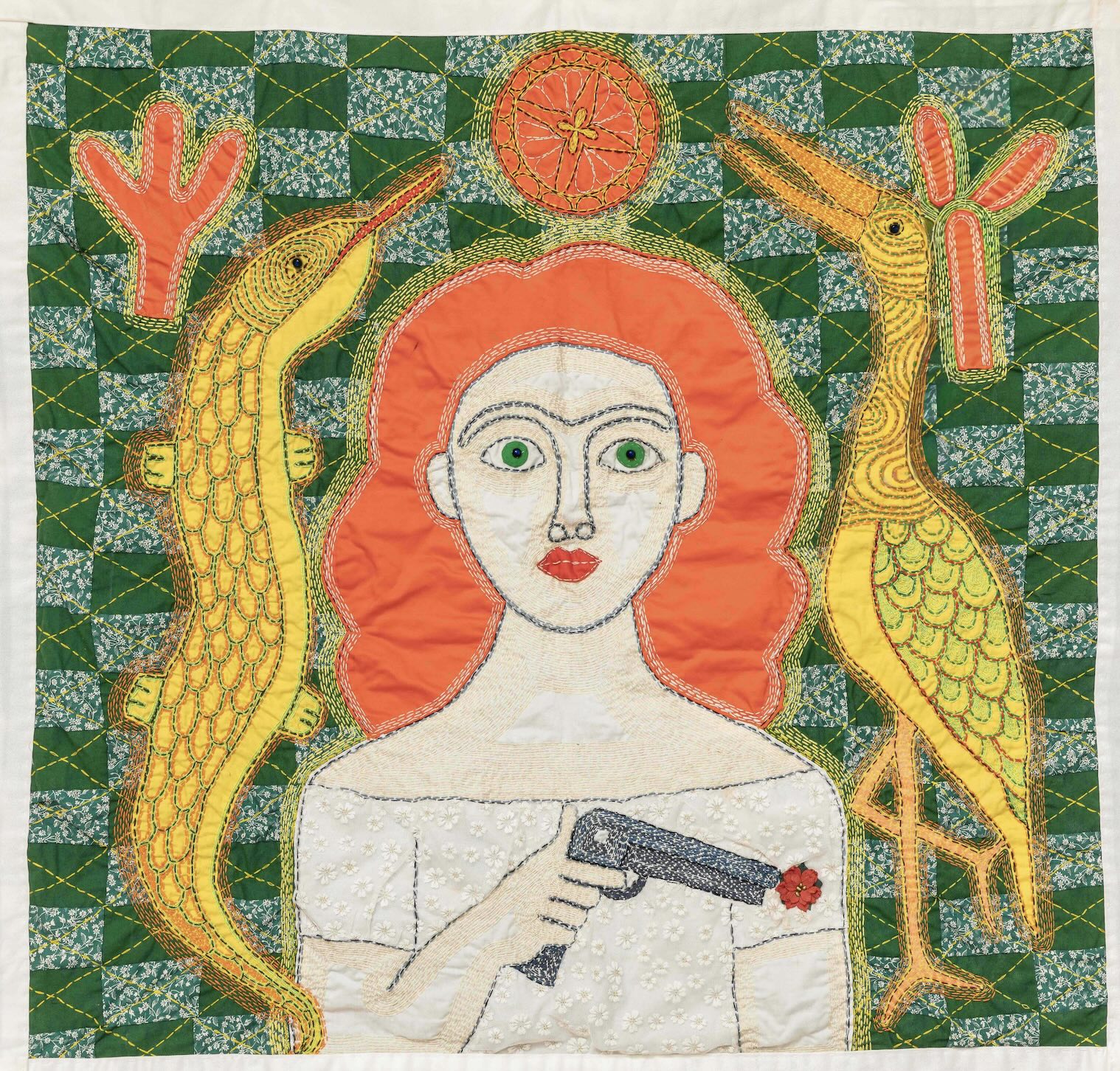
Helsinki-based Iraqi textile artist Kholod Hawash (b. 1977, Basra) speaks to bayn/space about the cornerstones of her artistic practice and the intricate technique of jodaleia (quilting) she utilises. Hawash is embraced by the Finnish institutional scene: her work is in several museum collections including Kiasma, the country’s most important contemporary art museum. In 2024, Hawash represented Finland in the Venice Biennial in Nordic countries’ pavilion which presented The Altersea Opera. In the spring of 2026 Hawash debuts in Qatar in a solo show Holding Dreams organised by Sana Art and Katara Art Centre.

You utilise an Iraqi crafts technique called jodaleia (quilting). Since when have you been interested in it? What attracted you in the technique in the first place?
Kholod Hawash: Indeed, my technique is primarily based on jodaleia, a traditional Iraqi craft that focuses on recycling fabric scraps and hand-embroidering them into warm and decorative blankets. In my practice, I take this technique and transcend it, transforming it into a narrative mural. I use patchwork to build the backgrounds, and then add layers of hand-cut appliqué to depict figures and symbols, and finally, the stitching completes the background.
My relationship with this technique began in my childhood in Iraq; I grew up watching my mother collect fabric scraps during the years of economic sanctions on Iraq, transforming them into something both useful and beautiful. However, I only began using it as a primary artistic tool in my professional career in 2014.
What drew me to this technique was the lack of understanding of its importance as an art form in Iraq, and the under appreciation of its remarkable ability to preserve memory; every small piece of fabric carries a history, and every needle stitch is a cry or a whisper. I was drawn to it because it is a distinctly ‘democratic’ and feminist art form, born in homes far from the rigidity of academia. The technique also has a personal significance for me as living in exile I am far from my homeland. Jodaleia allows me to connect with my Mesopotamian roots in a tangible way that transforms silent threads into stories that pulsate with life.

You predominantly feature women in your work. Could you tell us more about this?
Kholod Hawash: The presence of women in my work relates to the struggles they have faced during the whirlpools of wars and political transformations in Iraq. I do not just paint women as aesthetic icons, but I embody in them the memory of Iraqi pain; for it is she who faced loss, displacement, and the torments of the siege, and she who is still struggling to obtain her most basic human and social rights.
In every artwork I create, there is an attempt to document the stories of women who have paid the heaviest price in conflicts in which they bear no responsibility. The suffering of Iraqi women is reflected in my work through the layering of fabric and the patience of the craft. Every stitch is a mending of a wound, every piece of fabric an attempt to conceal a violated memory. I use art to say that a woman’s body and soul are not a battleground, but rather the source of life that must be protected and respected.
My mother and the women around her used to knit quilts to protect us from the cold, and today I knit these stories to protect women’s rights from being forgotten. In exile, I find myself even more driven to shed light on this suffering, so the world knows that behind every piece of fabric I make, there is a strong, patient, but also pained Iraqi woman demanding her right to live with dignity, freedom, and safety.
I see woman as a symbol of Mesopotamia itself; she is fertility, she is the river, and she bears the burden of both history and alienation. In my work, woman appears strong, dignified, and surrounded by symbols inspired by Sumerian and Babylonian mythology, where female deities represented wisdom and power. Woman in my work is a rich history of glory and suffering.

Indeed, many of your textile works include a female character seeking freedom and emancipation.
Kholod Hawash: Precisely. Highlighting the freedom of Iraqi women in my work is a moral imperative before it is an artistic one. Women in Iraq have endured decades of suffering, caught between the hammer of war and the anvil of restrictive traditions. Through jodaleia I attempt to break the silence surrounding their denied rights, transforming each stitch into an act of rebellion that reclaims their dignity.
I believe that women’s freedom is the cornerstone of societal stability; therefore, I depict them striving for liberation, reminding the world that behind every piece of fabric I create lies the story of an Iraqi woman resisting marginalisation and demanding her right to a safe and free life.

As you mentioned earlier, Iraqi folklore and myths also play a hugely important role in your work. Could you tell us more about the importance of including references to your heritage?
Kholod Hawash: Incorporating Iraqi folklore and mythology into my work is not merely a revival of ancient symbols, but a reclamation of identity in its purest form. I am a daughter of the Mesopotamian civilisation, and for me, Sumerian and Babylonian symbols are not bygone tales, but keys to understanding our resilience today.
In my exile, this heritage has become my ‘portable homeland,’ which I scatter across the canvas to reconnect the threads of memory that diaspora has attempted to sever. The significance of this heritage lies in its overwhelming identity, both in form and content. As a universal language that carries the flavor and pain of the Iraqi land, I do not chronicle kings and wars, but rather the land, the people, and the myths that have given us the strength to endure. Integrating myth with the everyday is a message to the world that Iraq is not only an arena of conflict, but also a wellspring of beauty and philosophy. I weave myth to make it contemporary.

There is a beautiful contrast between the strong feminist messages in your work and the magical universes you create. Could you tell us more about the aesthetically development in your work and this inherent contrast?
Kholod Hawash: The evolution of my aesthetic style has been a conscious journey to balance the humanistic message with visual language; I firmly believe that works of art should not be mere political statements or dry, direct condemnations. Art, in its essence, should remain art, soaring in the realms of imagination, and breathing through visual aesthetics and technical innovation.

Kholod Hawash: Holding Dreams is on view at Katara Art Centre in Doha, Qatar until 31 May 2026.
You might also enjoy: