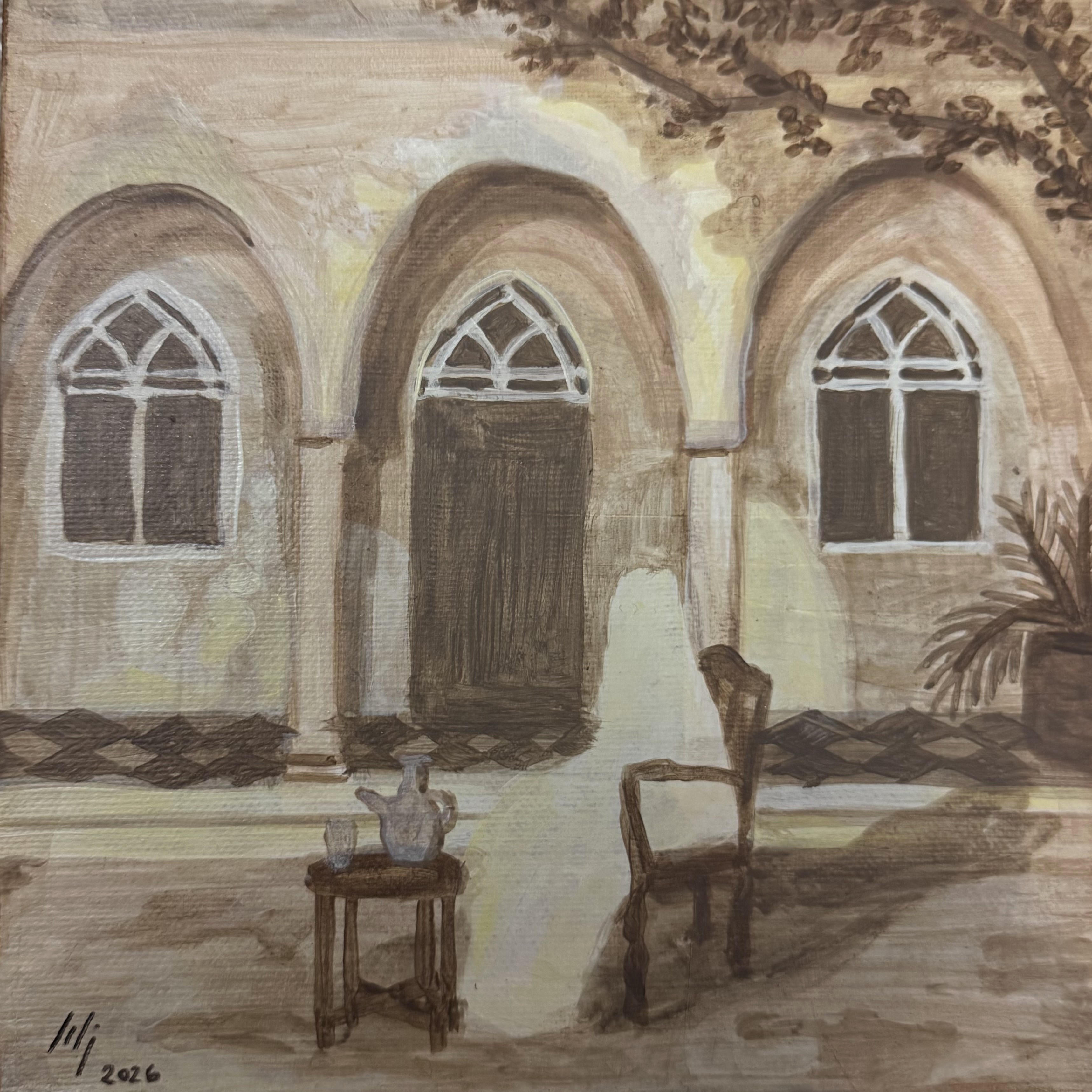
Bahraini architect-turned-artist Huda Jamal speaks to bayn/space about the tension between darkness and humour in her work and the negotiation between personal and collective memory. In her practice Jamal presents a deeply layered approach to space—one she traces back to the design principles that shaped her architectural training. Her work is increasingly directed towards themes of belonging and connection, drawing inspiration from poetry and the textures of everyday life.

You are trained as an architect, could you tell us more about your path of becoming an artist?
Huda Jamal: Both my architectural practice and my artistic practice are linear to one another. Ever since I was younger and still experimenting with art, I was very focused on the fundamental design principles (order, symmetry, balance, etc.) that are essential to my work as an architect. The more I gained experience in shaping three dimensional spaces, the further I focused on structure and axis in my paintings and compositional layering.
The negotiation between personal experience and collective memory is at the heart of your work. Could you tell us more about how your work has developed throughout the years?
Huda Jamal: Yes, personal experience was always the foundation of my practice, even when the context of the painting included a rather socio-cultural theme, I always tried to create space for viewers to connect the work back to their own experiences. I have recently shifted the gear, focusing more on passion and intimacy, while exploring how I can transform literature into a tangible artwork, while still maintaining the personal element as a focal point.
There is a prevailing sense of darkness in your work. While the darkness is there, there is also a lot of humour, too. How did this tension and dichotomy come about?
Huda Jamal: When I began exploring these two emotions, at times independently and at times within the same context, my primary interest was centred on perception and the way it shapes our understanding of experiences. In everyday reality, these emotions are often perceived as opposites, and we tend to separate them rather than associate one with the other. However, when both coexist within a single situation, the interpretation becomes entirely dependent on individual perception, leading each person to form a subjective judgment based on their own perspective. It is this subjectivity, and the ability to challenge and question perception, that I like to be present within my work.
How has the relationship between the two, namely humour and darkness, developed?
Huda Jamal: This mainly relates back to my character as Huda. During my brainstorming process, I mostly base it on external observations, but I would say that the humorous elements I occasionally incorporate into my paintings are the closest reflection of my personality. Despite the serious themes that may be present within my work, I am not someone who approaches life with excessive seriousness. If anything, I am constantly seeking moments of amusement and lightness within every situation I encounter.

Could you tell us more about the continued series “Wrong place, right timing”?
Huda Jamal: After completing the first part of the series, I felt the urge to pursue a more detailed and location-specific approach that could create a deeper sense of connection, rather than relying solely on a landscape to define the context. This led me to incorporate additional furniture, patterns, and surrounding details that contribute to shaping the narrative within each artwork, where every added element plays a role in enriching the concept.
You have noted earlier that this series is about the ‘right moment’ and the ‘wrong place’. Could you please elaborate?
Huda Jamal: Our times have been changing continuously, sometimes those changes can become so overwhelming that we, ourselves cannot keep up the pace, which results in feeling out of place. The series aims to illustrate the notion of that struggle–whether it is from within, or with your surroundings, which closely reflects the trajectory of life itself. Especially when you feel like things are finally aligning for you in a certain age in time, but you find yourself in the wrong place.

Your experiences as a Bahraini woman are also central to your work. Why do you find it important to address your cultural background?
Huda Jamal: Bahrain has undergone a significant transformation over the last 25 years. Within the context of art, I believe that as a contemporary artist, it is important for me to highlight the everyday elements that resonate with modern society, rather than relying solely on references that may no longer feel relatable to current audiences. The moment I decided to position my work within a more international context was the moment accurate representation became far more meaningful to me.
Are we to read your work as a cultural commentary or is it something more personal?
Huda Jamal: I think it is a mixture of both, I always ensure that the personal element exists, but remains beneath the surface and would only make sense to me. Meanwhile i try to highlight the cultural relevance and push it forward to my audience.

In addition to portraying emotionally charged characters the presence of various interiors is also common in your work. Could you walk us through these stages?
Huda Jamal: The interiors I choose to include in my paintings somehow serve the purpose of strengthening the composition, each element is there to send a message, to further support the presence of the human figures being the primary focus in the painting, but everything is intentional, every pattern, every lamp, every plant is intentional and had to be placed there.
In your more recent work you are also increasingly portraying men. Could you tell us more about this shift in your practice?
Huda Jamal: The portrayal of men has become more prominent in my recent works, particularly as the direction of my artistic journey shifted beginning in 2026, when I started drawing inspiration primarily from poetry. The presence of both men and women within the compositions often reflects the relationship between the writer of the poem and the individual who inspired it. In many ways, the works have become narrative-driven — representing my own interpretation of love stories, and in some cases, stories shaped by tragedy and emotional complexity.
What are you working on at the moment?
Huda Jamal: I am currently working on several projects, both independently and in collaboration with others. I will soon be participating in an upcoming exhibition in June, which I am very excited about. As I am also contributing to a personal photography-based project in collaboration with an author based in Brooklyn. Also, I am in the process of creating an artwork specifically for a magazine initiated by a fashion stylist and editor based in Italy as part of her thesis project. I would say i’m very much looking forward to sharing my upcoming work.

See Huda Jamal’s portfolio here and follow her on Instagram here.
Featured image: Huda Jamal, The Return (2026), acrylic on canvas, 20 x 20 cm.