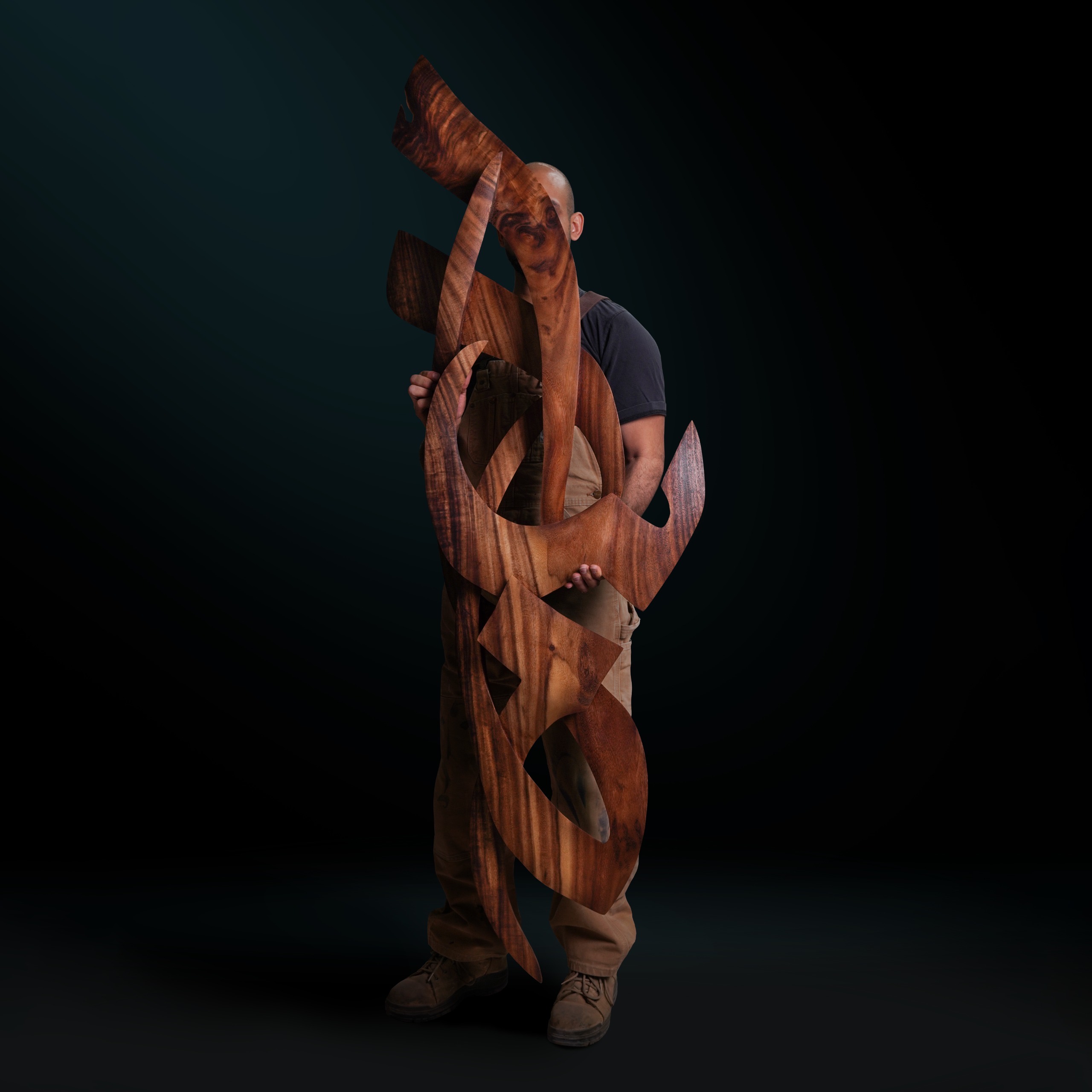
After seventeen years in the oil fields Saudi sculptor and calligraffiti artist ALIF (b. 1986, Tarout Island) decided to pursue arts seriously. In an interview with bayn/space he speaks about newfound commitment and artistic practice rooted in language, materiality, and the spiritual sphere. ALIF’s work transforms Arabic calligraphy into a sculptural form, exploring the letter not merely as a visual structure but as a carrier of emotion and meaning.

You hold a BA in English Linguistics and Translation from King Khalid Univeristy in Abha (2008) and had a number of positions in the oil business before becoming an artist. Could you tell us more about this transition?
ALIF: My BA in English linguistics came from a deep admiration for language, for the weight of a word and its ability to move people’s hearts.
I spent seventeen years in the oil field, a world I chose for its absence of routine. It is defined by constant movement and continuous problem-solving. That rhythm shaped me deeply through adaptability, discipline, and momentum.
From that experience, I carried respect for material, as well as practical skills in working with tools and systems, all of which later became essential in my artistic practice.
The transition into art was not sudden. It was a long accumulation of conviction. Over time, I realised this was the path I needed to fully commit to, to be able to live fully and purposefully.

Your artistic career started with graffiti in 2014. What is your relationship to graffiti? Did it develop in relation to some underground culture?
ALIF: My journey began with calligraphy, and graffiti came as an organic extension, a public voice defined by freedom and accessibility. I have always believed art should belong to public space, adding depth to how people experience their cities and surroundings.
And even after moving into sculpture, that connection remained present, especially in my public works.
Your first major graffiti–or calligraffiti–works was the poem Al-Awda (The Return) by Adnan Al-Awami on the walls of Hammam Tarout. Could you tell us more about this project and how did it come about?
ALIF: Al-Awda remains a defining moment in my practice. It was painted on the walls of Hammam Tarout, in front of the 5000 years-old Tarout Castle, and marked a major shift in scale for me, from small surfaces to a mural over 21 meters wide.
I executed the piece entirely myself, which made it both demanding and formative at the time.
It took me quite some time to embrace the place and select a poem that matches the site and its historical weight. It remains a work that puts a smile on my face whenever remembered.

Later on around 2018 you started to explore sculpture. Could you tell us more?
ALIF: My transition into sculpture began unexpectedly, through cooking. Cooking has always been part of my life. It feels like one of the purest forms of art because it disappears, leaving only the feelings it creates around the table.
That sensibility led me to carve my own wooden spoon. I realized carving could reveal forms already hidden within the material rather than impose them. The process became deeply intuitive and engaging.
I continued carving spoons, then introduced calligraphy into the work. The first Soul Nutrition spoons collection marked a turning point, after which I established my studio, where I still work today.
Your best known work is arguably the sculptural compositions that reimagine Arabic calligraphy at the intersection of contemporary art and heritage. What is it about calligraphy that interests you? How do you see the relationship between calligraphy and graffiti?
ALIF: My interest in calligraphy comes from two layers. Culturally, it reflects the artistic DNA in the Arabian Peninsula where art has historically been rooted in language, poetry, and speech rather than visual imagery, perhaps also shaped by visually poor environmental stimulation and lonely long travels. And even today, when artists from the region work visually, words and calligraphy remain strongly present as part of their paintings or sculptures.
On a personal level, words carry human weight. They are not only visual structures but carriers of meaning and emotion. When translated into form, they feel alive.

Thematically you explore the themes of emotions, spirituality, and connection by transforming letters into physical forms that are both poetic and deeply connected to material. Could you share more insights into the ways your work has thematically developed over the years?
ALIF: My early work explored love in a more direct way, alongside themes of land and people. Over time, this evolved into a more spiritual direction.
Today, my focus is on the relationship between the human and the divine, and on love as a force that connects us, to God, to others, and to ourselves.
For me, love is the foundation of meaning. Without it, life loses its drive toward purpose and growth. As we say in our culture: what is religion if it is not love?
Speaking of materiality, as a sculptor how do you approach materials? We understand that wood, in particular, has a special place in your heart.
ALIF: A tree feels closely connected to the human condition. It grows upward, feeds from the earth, and continuously expands — much like how humans build themselves and their lives.
A tree gives back through fruit and shade. I believe a human should carry the same essence: to contribute positively, even in response to negativity.
This is why wood holds such importance in my practice. It feels alive and familiar.

In 2025 you completed two granite sculptures. How was the experience of working with stone?
ALIF: I once thought of granite as silent and lifeless, but working with it revealed something very different.
Its resistance creates a strong dialogue between artist and material. Shaping it feels like both struggle and conquest, in a deeply rewarding, almost physical way.
Because granite lasts for thousands of years, it feels like something primitive, like marks carved in caves by the first man.

In 2026 you participated in the POUSH Residency in Paris. How did this experience affect your artistic practice?
ALIF: The call to Paris came at a pivotal moment, right after I left my previous career. It felt like confirmation that I had made the right decision to fully commit to art.
This special residency offered complete freedom, with absolutely no defined outcomes. That openness allowed me to slow down, and observe my practice and inner drive from a distance.
What made the experience powerful was the space itself and the team behind it, along with the atmosphere of Paris in winter, and the sweetness of macarons.
What I realised there is that I traveled all the way to Paris only to find out that art is not there. It is not in my island either. It has always been inside me.
In that sense, POUSH didn’t give me art, it removed the noise and reminded me that my role is simply to keep digging in the right direction, and to stay honest with that process.

ALIF is currently exhibiting for the first time in Doha, Qatar at Katara Art Centre. Out of Black is on view until 31 May 2026.