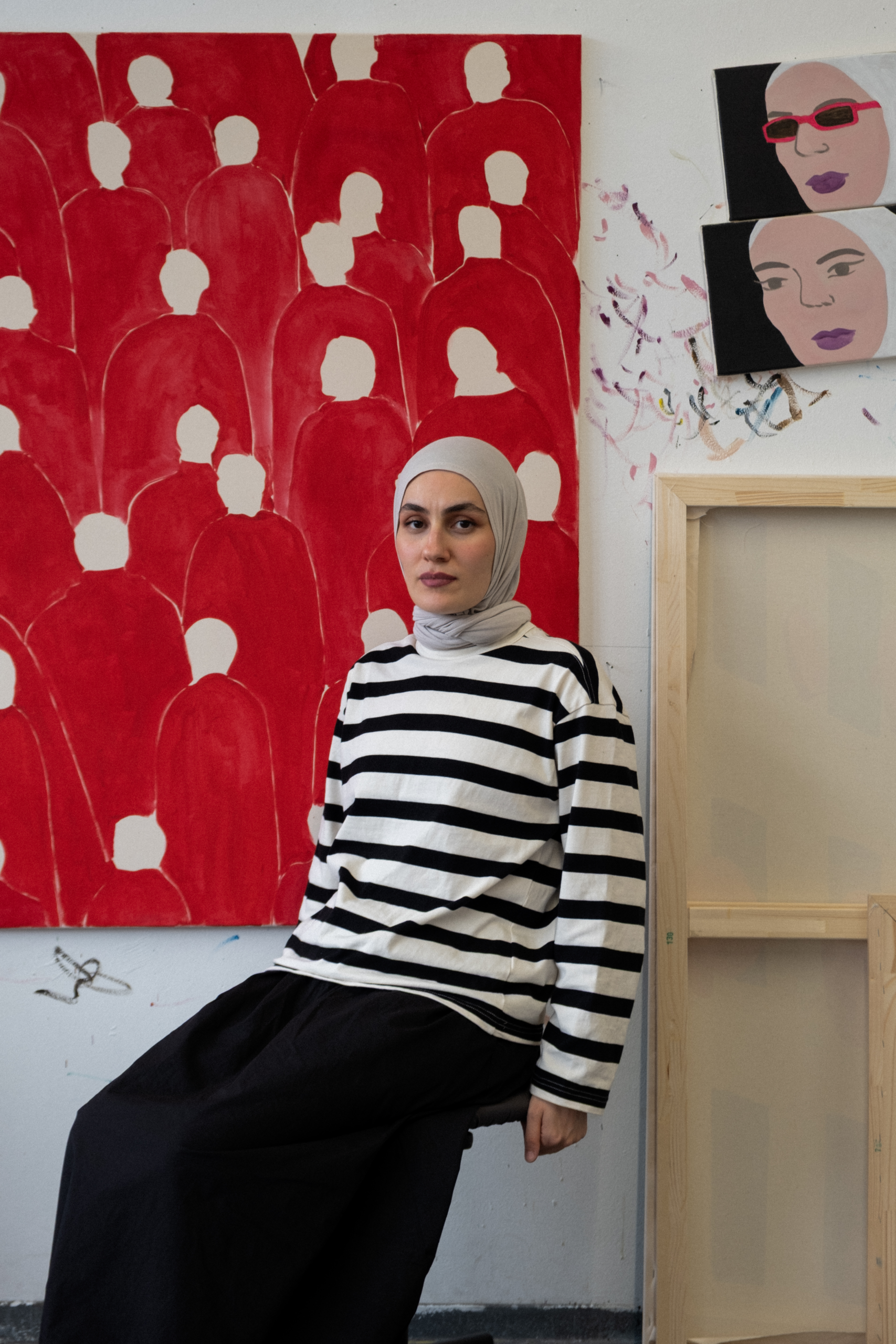
German-Turkish painter Elif Çelik, based in Germany, speaks to bayn/space about the power of self-definition, the politics of the mundane, and the liberation that comes from letting paint simply be paint. Trained in Stuttgart, Karlsruhe, and Istanbul, Çelik’s practice has moved from distorted, dissolving figures, bodies resisting the weight of an external gaze, to the quiet, repetitive rhythms of everyday objects and devotional imagery, where irony, faith, and the pure pleasure of colour coexist on the same surface.

You studied at the State Academy of Art and Design in Stuttgart and at the State Academy of Art in Karlsruhe as well as at Marmara University in Istanbul. Could you tell us more about your decision to pursue a fine arts career?
Elif Çelik: To be honest, it was a dream I did not even dare to utter out loud at first. As the first child in my family to ever go to university, I faced completely different expectations, which is quite typical for many working class families. The wish was for me to pursue a secure career path like becoming an engineer or a teacher. However, since I attended a school with a specialised art track, I primarily owe it to my art teacher at the time. She recognised my potential and tirelessly motivated me to follow the path of art. There is a little anecdote about this: when my art class visited the Weissenhofsiedlung (modernist housing estate) in Stuttgart in the 10th grade, the itinerary included a visit to the art academy. I deliberately chose not to go inside because I thought, ‘That’s something I will never be able to do anyway’. In the end, at the very last minute, I decided to apply there simply because the Stuttgart Academy was the only art school I even knew of and the one closest to my hometown. It was not a long, strategic research process about what would suit me best; it was a completely intuitive decision.
My time at Marmara University in Istanbul was a direct result of my experiences at the German art academy. There, due to my Turkish roots, I was noticeably often questioned about how they related to my art. Until then, I had always perceived myself as German, and suddenly I felt this self-definition being stripped away from me from the outside. The power of definition did not lie with me. Instead, I was categorically assigned to a specific culture and identity by others. I wanted to go to Istanbul to actively confront this imposed search for identity and to get a glimpse of the art scene there at the same time. The Karlsruhe Academy, on the other hand, was a shorter, very targeted stay because I specifically wanted to study under Tatjana Doll, who runs a painting class there. That was a truly valuable experience for me.

You have noted previously that your paintings do not exist to explain anything and that they simply stand there. Are you looking to connect with viewers on an emotional basis then? Or do you leave such any connection, whether intellectual, political, aesthetic, or emotional, to the viewers alone?
Elif Çelik: Yes, ultimately I leave that connection entirely to the viewer. When I paint my mother’s pickle jars, for example, at first glance they are just pickles, colourful and aesthetic. For me personally, of course, they mean something completely different. Everything I paint, and all my ideas, are filtered through my heritage, my experiences, and my own stance. For me, those jars contain my mother’s love, her culture, longing, and diversity.
But this process happens completely automatically while painting. In that moment, I choose the motif because it is formally strong and the colors inspire me. Knowing that my own gaze is already shaped by all these profound themes makes the work valuable and inherently political in reverse, without me having to explain it in a cliché or performative way.
You have also noted that displacements, loss, and the necessity of constantly relocating oneself form the backdrop for your artistic work. Could you tell us more?
Elif Çelik: This basically connects directly to what I just described. I am deeply shaped by these themes, especially by longings, grief, loss, and the constant necessity of adaptation. All of this constitutes my identity and is the breeding ground from which my art emerges. It is an inner pool of inspiration that I did not have to artificially acquire because it is simply there.
Every conversation I have and every glance in everyday life triggers these experiences, in both a negative and a positive sense, and it is precisely this resonance that I bring to the canvas.

I came to know of you around 2022 I think, and at the time you were painting boneless, distended figures with anatomies that were nearly liquefied. To me these figures resisted stable selfhood as the limbs proliferated and dissolved. At the same time there were vernacular clues such as çay glasses and a watermelon as well as references to both Jesus and Saint Sebastian. Could you tell us more about this series?
Elif Çelik: At the time, this series was my artistic solution for finding a way to cope with the constant feelings of adapting and the sensation of being uninterruptedly observed. With these paintings, I tried to understand and visually process this intense reality. Eventually, however, this approach stopped working for me. I got caught in a dynamic where I felt I had to constantly explain what I meant by the distortion of the bodies, specifically that these figures are staring back to reflect society’s gaze.
In doing so, I realised that I was inadvertently surrendering the power of definition over my own experiences of racism to the audience. The pressure to explain became so immense that I grew rigid; I desperately wanted the viewers to understand exactly what I meant. When that did not succeed or did not come across convincingly, it no longer fulfilled me artistically. Furthermore, continuing to develop these distorted figures purely for formal-aesthetic reasons would have ultimately corrupted my political self-positioning.
Therefore, I radically changed direction and began depicting seemingly mundane everyday realities, such as veiled women swimming or behind the wheel of a car. That was precisely the point where it was mirrored back to me that this is actually what people don’t want to see. And for me, that was the signal to keep pushing even harder. The tea glasses and the Christian iconographic symbols in the earlier series were essential transitions for me to build visual bridges between cultures and religions. Saint Sebastian died because he helped persecuted Christians, a sacrifice and pain that I deeply resonated with and interpreted in my own way. Perhaps that also contained my desire at the time to generate a very specific form of visibility.


Throughout your practice you have also often referenced religions, both Islam and Christiniaty, in for example Francis (2025), Make Dua for My Mercedes (2024), and in Praying for the Margielas (2024). What is the importance for such dialogue in your view?
Elif Çelik: Religion plays a fundamental role in my life and, consequently, in my artistic practice. Simply through my visible Muslim identity, specifically because I wear the hijab, I am permanently confronted with it in daily life. This is a constant catalyst for my paintings. For me, the act of painting, the creation of art itself, almost has the quality of a religious service.
At the same time, I also really like to use religious references in a humorous way to lift the paralysing gravity of the subject matter. Globally, religion is so oftenintertwined with violence, death, and contempt; I simply love to break this deep seriousness with wit and irony. My personal stance articulates itself within these fine nuances, and that is extremely important to me.
In these two paintings, namely Made Dua for My Mercedes (2024) and Praying for the Margielas (2024), the ironic tone towards consumerism and brand culture is also quite evident. Did you create these works in relation to the commodification of religion?
Elif Çelik: The diptych Praying for the Margielas emerged from an existential question that I have to repeatedly ask myself as an artist: Who or what am I actually making art for? Am I painting for the Margielas that I can buy when a work sells? Or is my art my personal da’wah, meaning my calling to faith and my service to something higher? These are open-ended questions.
Of course, this heavily addresses our consumer-oriented behavior. This constant tension between the art market on one hand and ‘art for art’s sake’ on the other inevitably provokes these questions: Why do we desire art?
Answering this capitalist longing with religious ciphers makes total sense to me. As I said, I understand artistic creation as a form of worship, viewing it as my tool to live out my spirituality for myself.
I find the contrast with consumerism simply incredibly humorous. Many people have a very rigid, cliché-ridden perception of religions. The specific prayer posture in the Margiela paintings is usually only recognised immediately by Muslims. That is the inherent joke because, in the end, we are all equally victims of consumer media.
Driven by this impulse, I also painted a woman with a hijab featuring a marijuana pattern. It breaks expectations and raises the question: How do we look at things, and what do we project in reverse? If the subject were an elderly lady, we might find the motif simply quirky or cute. But how does another hijabi look at it? Does she feel provoked because she claims to be doing it ‘right’, while the marijuana pattern is ‘wrong’? Isn’t there a certain spiritual arrogance in that?
Often, the hijab itself is sacralised as something absolutely holy. But the fabric itself is not holy, since it is the woman who self-determinately decides to cover her head who deserves the respect, not the textile.

In your more recent work you have also turned to the overlooked and embedded rituals of hospitals and objects of domestic and cultural life. Within Sari Kola (2026) and Turşu (2026) the logic of repetition is also clearly present. Could you tell us more about the shifts in your work?
Elif Çelik: I think this connects directly to my answer regarding the pickle jars. Focusing radically on pure colour and the simplicity of the object had something immensely liberating for me. By doing so, I stripped away the immense pressure to demonstrate an explicit, immediately decipherable political stance in every single piece. My mere existence as an artist in this space is already political enough.
The repetition of the motifs has a purely stylistic reason because it creates a pattern and a nearly homogeneous mass, even though they are simultaneously a multitude of solitaires, representing individual things. Sometimes it feels incomplete to execute a brushstroke, whether simple or swiftly placed, only once. When I am in a creativeflow, I want to see that movement multiplied. That is precisely why serial repetition works so well for me formally.

I am also quite intrigued by the mandorla or the radiant halo structure of Byzantine and Catholic devotional imagery in Kaktusfrau (2026). The diptych structure somehow suggests presence and absence, the icon with and without its subject. To me this poses the question who gets to be seen and what remains when the face is removed? What is your perspective behind this work?
Elif Çelik: Kaktusfrau (Cactus Woman) is essentially a very humorous, almost ironic painting. It plays with the stereotypical and often flat metaphor in art history of preferentially associating women with playful, delicate flowers, which is an expectation that a prickly cactus completely shatters. Historically, the cactus was certainly used as a symbol to characterise women as sharp-tongued, defensive, or unapproachable.
Picking up this motif visually in a way that evokes the aesthetics of a hijab was an exciting extension for me. It has something of a costume, almost like a masquerade. Perhaps I also wanted to reveal the subconscious fears some people harbour toward strong women. For me, the work emerged from a decidedly feminist motivation.

What are you working on at the moment?
Elif Çelik: I am working intensively on becoming even freer in my painterly practice. I want to turn off my mind, to simply enjoy the pure process of applying paint and the brushwork itself. Right now, it is about visually capturing fleeting moments and experiencing painting in its purest, most unadulterated form.
How is the scene for emerging artists in Germany?
Elif Çelik: Years ago, I probably would have said that it is extremely difficult, especially for artists who wear a hijab. Of course, it still is today because structural visibility is still not where it should be. However, my earlier perspective was probably also coloured by personal pessimism and very harsh self-criticism.
Looking back, I can say that I am one of the first hijab-wearing artists in the German art scene. It was a hard road to even demand a certain self-evidence for my presence, enduring racist comments and skeptical glances. By now, I can look back on a wealth of experience, and my self-worth regarding my work has fundamentally solidified. Today, I know with absolute certainty that my art possesses high quality and is socially important.
The art scene in Germany might be structurally more difficult for me to break through because explicitly political content is often less valued as pure collectible objects on the commercial market. On an institutional level, meaning in museums and art associations, the interest in such discourses is far more sustainable. After all, we have deeply rooted colonial and Eurocentric structures in Europe that will not dissolve overnight. These are slow but therefore continuous and fundamental steps forward.
Nevertheless, I still experience the art system as a structure that quite clearly excludes certain marginalised groups and PoC. I can imagine that Francis (2025) will never be exhibited in a German museum.
