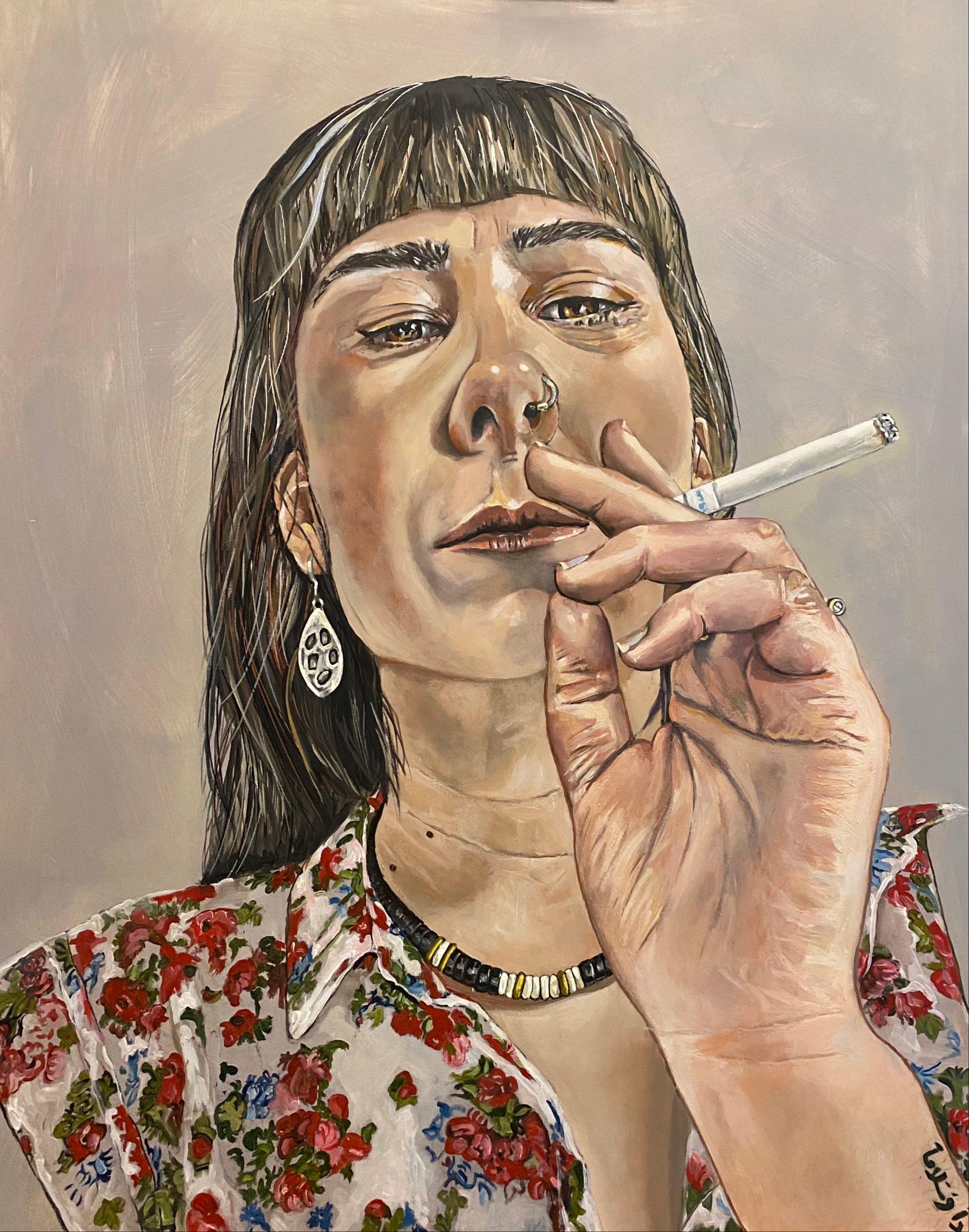
Beirut-based painter Maysam Hindy speaks to bayn/space about painting as confrontation and what it can hold that language cannot. In Hindy’s work, the figure is never fully resolved but suspended in a state where presence and absence coexist, and where intimacy and distance occupy the same surface.

You graduated with an MFA in 2020 from the Lebanese University. Could you tell us more about your decision of pursuing a career in the fine Arts?
Maysam Hindy: I never experienced art as a career decision in the practical sense. Painting felt more like a condition of perception—a way to survive, observe, and translate something that language often fails to hold.
I studied economics first, but I felt lost in it, even though I loved its logic. I decided to study Fine Arts to escape what I already knew. I always felt I had to find new questions about life, and a deeper realisation of myself.
Studying painting gave structure to something that already existed instinctively within me, but it also forced me to confront it differently—not as expression, but as ethics, memory, and weight.
What drew me toward painting was not only the image itself, but the possibility of creating presence: making silence visible, vulnerability tangible, or absence materially present. I was never interested in spectacle. I was trying to understand what visual language can hold.
Painting, for me, is a revolutionary act, but separate from political revolutions and artistic movements. It provokes the unknown. The surface of the painting is built on probabilities whose consequences you cannot know in advance, yet they are what the painting becomes.
Sometimes I think painting is an individual problem the painter invents with themselves. It is an act of contradiction: doubt and possibility running in parallel with hesitation and decision, concealment and confession. I paint because there are things I cannot fully explain in language, and writing becomes a way to understand why I need painting, and why I sometimes avoid it.

You are predominantly a portrait painter and you believe that a portrait is a medium of self-discovery. Could you please elaborate on this statement?
Maysam Hindy: I am not a portrait painter, I am a painter who keeps returning to portraiture because it resists closure.
My references, for example Edward Hopper, Frida Kahlo, Lucian Freud, and David Hockney, all dealt with the figure in ways that exposed psychological distance rather than resolving it. I stay close to that tension, but I avoid their solutions.
For me, portraiture is not description. It is a confrontation with what resists description. It cannot remain only a ‘good portrait’. It has to become a situation where body, space, objects, and silence carry equal weight. It becomes almost anti-portrait in relation to its historical function. It should not praise anyone; it should expose something true in emotion.
When I speak about self-discovery, I do not mean confession. I mean that the act of looking is never neutral—it exposes fear, affection, distance, projection, and the limits of knowing someone.
I am less interested in likeness than in what remains after likeness fails—psychological realism, or a weight that stays in the image without becoming narrative.
I think painting also reveals what I hide from myself, what I fear, what I remember and forget, what was and what I wish was. In that sense, consistency with the self starts to dissolve. I often try to paint what my fear sees, not what my eyes see.

This idea that painting another person is an act of self-revelation is often discussed in art history. Where does self-discovery happen for you? In choosing the subject or in making the portrait?
Maysam Hindy: I think self-discovery happens in both the choosing and the making, but especially in the duration of looking.
I do not choose randomly. I paint people I know, for example my family and my close circle. I cannot fake intimacy through a random face. I need a real psychological relation to the subject.
I started with myself, painting my own face and trying to understand it through observation—what it hides, what it reveals. Then I moved to people close to me.
Each portrait becomes a slow negotiation. It is not about arriving at an image, but staying inside uncertainty long enough for something to appear that I did not plan.
What I discover is not an insight, but exposure of limits—what I can and cannot see in someone, and what I project without noticing.
And the making itself is not calm. It is closer to exhaustion than expression. The anxiety starts before painting and does not end with it.

How do you find your subjects? Has that changed over time?
Maysam Hindy: I do not really ‘find’ subjects. I stay within my close circle and people I already know.
What makes someone paintable is not appearance, but what I relate to. I need to feel there is something unresolved beneath the surface.
Each face carries traces of memory, but I am more interested in the collective unconscious, that goes beyond individuality—loneliness, intimacy, love, aging, fear of loss.
Over time, I became less focused on the face itself, and more on the relation between the figure and what surrounds it—objects, interiors, gestures, silence, and absence.
I think I will always paint people, but alongside other genres: still life, landscape, space, and traces of human presence.

In your first solo show, Unspoken, you presented familiar people in their domestic spaces. What has made you interested in painting ‘ordinary’ people?
Maysam Hindy: I was never interested in ‘ordinary’ as a category. I was interested in familiarity.
I started with people close to me, and I called the series Unspoken because these portraits held things that could not be said. Not in a narrative sense, but in the sense that some emotional states don’t translate directly into language.
None of the subjects were fully comfortable facing themselves through the painting—there is a moment of exposure that happens through realism and attention.
The works were also political in a quiet way—because in moments of crisis, the boundary between private and social life becomes unclear.
Objects and interiors are not background. They carry memory, class, and psychological realism. Sometimes they speak as much as the figure itself.
I was interested in familiarity because it allows projection. The viewer recognises something without fully naming it.

In On the Way Home, ‘home’ becomes more than a physical structure. Do you see it as an extension of the previous series?
Maysam Hindy: Yes, but not in a linear way.
Unspoken was more about intimacy—people inside spaces that still felt held. In On the Way Home, the idea of home becomes more unstable.
Home is not only a place. It is memory, displacement, belonging, class, and inherited history. It can feel protective, but also heavy or unresolved.
The space itself becomes more active. It carries weight, as if it remembers more than the figures inside it.
So yes, it extends the previous series, but it also shifts it. The focus moves from the person alone to the condition they are inside.

There seems to be a shift in emotional tone between the two series. Do you recognize that?
Maysam Hindy: Yes, I recognise that shift.
The earlier works were more suspended—quieter, less compressed emotionally. The newer works are more pressurised.
It is not because something was added, but because less is being held back.
I became less interested in describing emotional states, and more interested in the tension between them—where tenderness and discomfort exist at the same time.
Even when nothing happens in the image, there is still some tension.

Your later works introduce more confrontation between body and space.
Maysam Hindy: Yes, but confrontation is not always direct.
It appears in the relation between the body and the space—when the environment is no longer neutral or supportive.
A figure can be still, but the space around it creates friction. I am interested in that friction—emotional, spatial, and sometimes social.
Interiors can hold intimacy and tension at the same time.
Interiors in your work feel charged rather than neutral. Is this a conscious decision?
Very conscious.
Interiors are never background for me. They are part of the structure of the painting.
Objects, furniture, textures — they all carry traces of time, class, memory, care, and neglect.
Sometimes a space holds more tension than the figure itself.
I construct interiors as something active — not setting, but weight.

Your figures often appear alone. What draws you to solitude?
Maysam Hindy: I do not think of it as solitude in a romantic sense.
It is more a condition of interior distance. Even when others are implied, the figure is not fully accessible.
It is not necessarily loneliness. Sometimes it is protection, sometimes withdrawal, sometimes something harder to define.
I am interested in that in-between state, where presence is not complete, and neither is absence.
And I think painting itself exists in that same space—it never fully resolves, and it never fully explains itself.

All images courtesy of the artist and Marfa’ Projects.