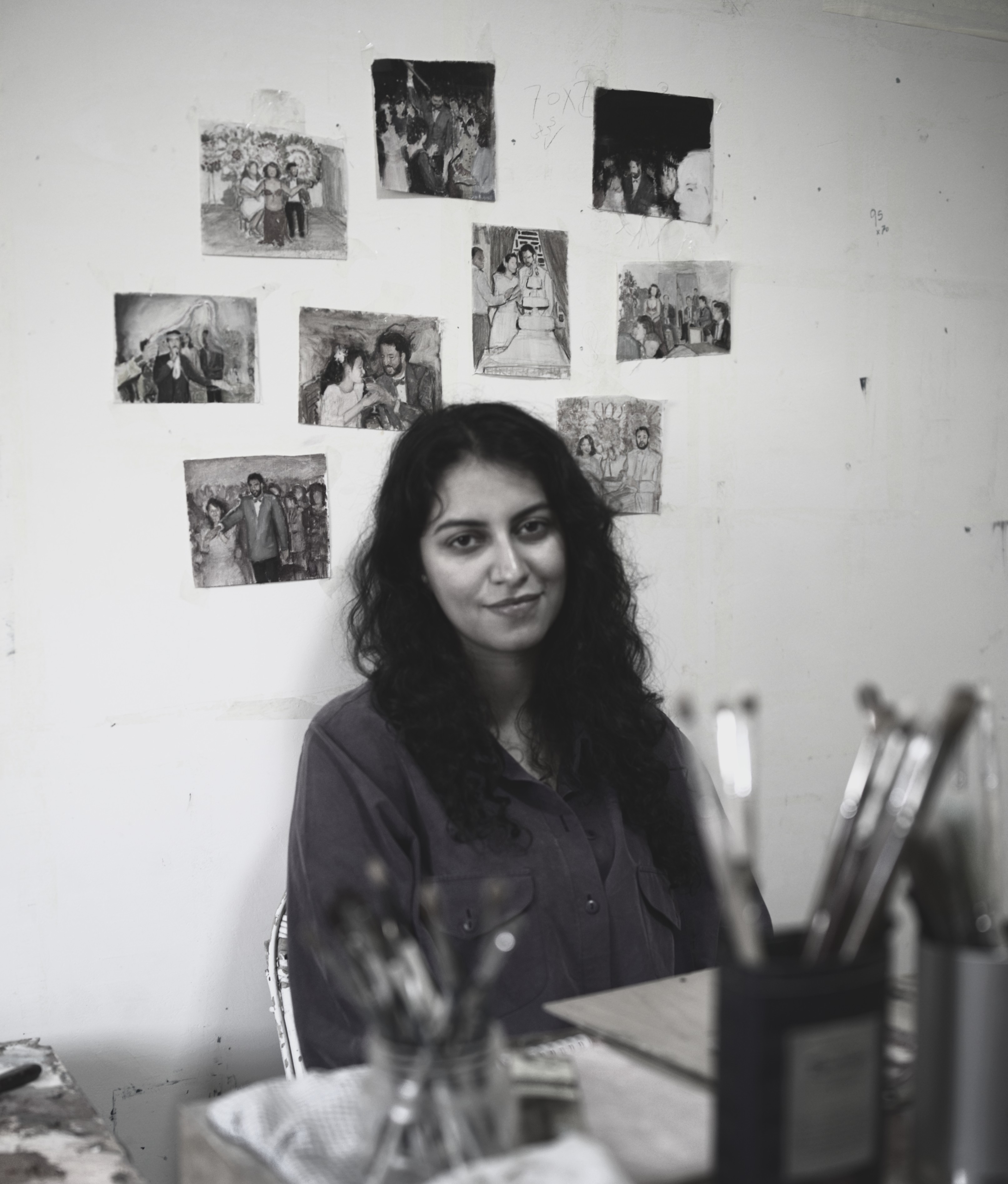
Egyptian painter Alaa Ayman speaks to bayn/space about memory as something summoned rather than chosen, and the way a photograph, a letter, or a cassette tape can become a doorway into another life. Drawing on a personal archive of found images and inherited objects, Ayman’s work builds individual mythologies from collective fragments. In a thorough interview Ayman discusses the cornerstones of her practice and shares insights into her work which honours our individual histories.

You graduated from Fine Arts in 2018 and continued to pursue Visual Arts at Studio Khana for Contemporary Art and Cultural Development in Cairo. Could you tell us more about your path of becoming an artist?
Alaa Ayman: Art was my way to express myself. When I was a child, I had a hard time speaking and expressing myself. I am not quite sure why, but language felt slow and confusing. As a child, I liked observing visuals, and I was drawn to book covers, furniture, decorative ornaments, and carpets. I also used to watch cartoons for hours. Studying fine arts felt like the most natural step for me.
I graduated in 2018, and during college I worked with different mediums. At first, I did not really like oil painting, but I eventually learned how to use it effectively.
What I experienced most in college was that technical and intellectual support was not always consistent. Theory was often taught, but sometimes it felt more like we were being spoken at rather than guided, and a lot of technical skills we were expected to figure out on our own.
So, I learned the most outside the classroom, through libraries and museums. That experience pushed me to keep learning. I attended workshops and courses whenever I could, not just for painting, but across disciplines: sewing, tailoring, and pattern making, writing, storyboard, and character design. I wanted to learn more about animation and filmmaking.
At Studio Khana, I had the chance to learn more about art history through reading and research. I was also challenged both technically and intellectually. The program involves research and experimentation using different media, so it pushed me to try beyond my comfort zone.
I especially valued the mentorship, the readings, and the discussions. Having that kind of guidance and dialogue made the learning process more directed and meaningful.
Overall, for me art started as something deeply personal, an outlet and a necessity. In my younger years, it was simply about creating moving my hands as my mind followed, and letting the process connect the two. That is still the core of how I think about art today.

Most of your work is inspired by memories, stories, or real life events through which you attempt to create your own individual mythology in order to reconnect with personal stories and history and collective memory. Could you tell us more about your approach? How has your work developed thematically over the years?
Alaa Ayman: At first, I was focused heavily on portrait painting, drawn to people with unique faces.
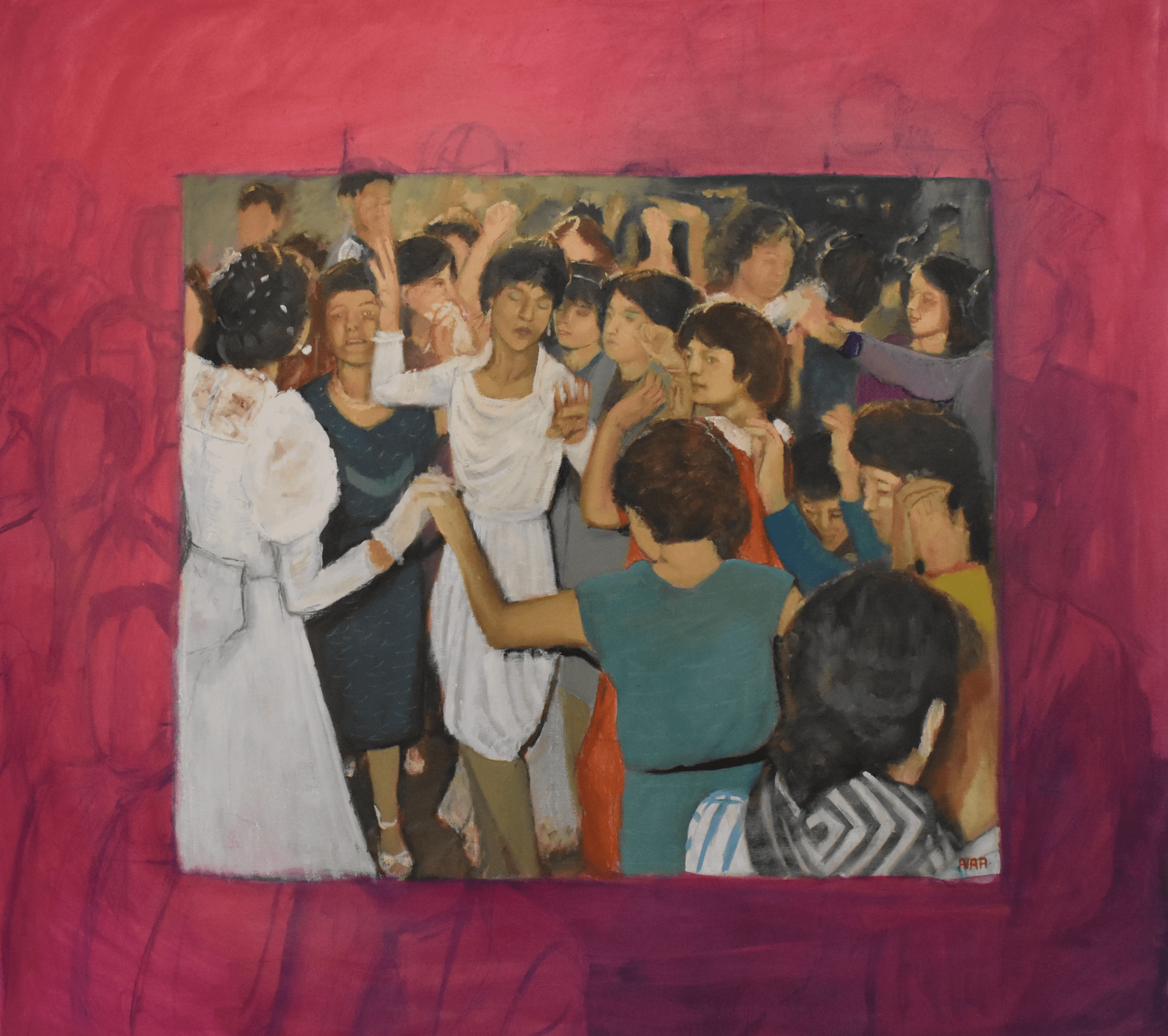
Then I started noticing something new: how people see themselves in gatherings and events, and how they pay attention, or perform presence when others are looking. That led me to use photography, and especially the idea of capturing moments.
To me, these images feel like a nod to the past, but they are about present relationships. Lovers, parents, friends, capturing intimacy in fragments. There is something sacred about holding an object that carries memory.
And when I paint from photographs, I am not overwriting history. I see it as a conversation: I am responding to it, carrying it forward, and letting it speak again.
How did this interest in archiving people’s stories develop over the years?
Alaa Ayman: My father photographed us constantly when we were little. our family, my cousins, the gatherings that held everyone together. There were so many cousins (around thirty), that our summers and celebrations always seemed to come with a camera nearby. He even taped our vacations on VHS, as if time itself needed to be archived.
In our home, collecting was not a hobby. it was a way of living. Old money, vintage cameras, antiques. I grew up with the quiet feeling that memories could be held, even if they were fading.
As I grew older, I began collecting too. I gathered photographs and old letters from my grandparents’ house, cassette tapes and small fragments that still carried voices. Later, I expanded my archive online, my friends’ family photographs, thrifted images, objects that weren’t mine, but somehow still felt like relatives of my own history.
I collect because I forget, and because remembering hurts in a gentle way. When I see these photographs again, time returns clearer than I expected. There is something sacred about touching an object that has already carried memory.

You also collect a lot of memorabilia, for example old photos, letters, tapes, and negatives. What interests you about such items?
Alaa Ayman: That is an interesting question, For me it is like I am gathering a trace of a person’s life (old photos, letters, tapes, negatives) They are unknown people, but there is this strangely familiar emotion in them. I get to feel their stories: their happiness, loneliness, longing for their loved ones. You can feel vulnerability in the smallest details. Letters carry the writer’s guard down. Tapes hold uncertainty in the pauses and the breath between words. Even photos there is something exposed about the way someone is captured, like they are trusting the future with a piece of themselves. Everything has a story to tell. It feels like constructing a contained world. Not the whole universe, just enough of a glimpse that you can sense it and almost taste and smell it. It is like those objects become a doorway. You step through for a moment, and you can feel how vulnerable we are as human beings.

When utilising a piece of another person’s history, say a letter or a photograph, without knowing the bigger picture of their life, how do you go on developing a narrative based on that? I guess what I am trying to ask is how do you combine the fragments of personal history in relation to your own imagination?
Alaa Ayman: At first I am not trying to paint, I am trying to listen. The scene arrives as imagery, sharp but incomplete, like a photograph someone forgot to finish developing. I notice the way they speak the pauses, the small certainty in their words, the way their voice leans forward when they mean something. Then I watch them in my imagination the way you’d watch someone prepare to be seen, how they adjust their posture for the picture. A hand shifts. Their shoulders settle. Their face chooses an expression that will ‘hold’.
Sometimes I begin the way an archivist begins, going through the archives, searching for one line, one scrap of text, one photo that feels like it is speaking directly to me. I pull it out and let it speak. And then I build a conversation around it.
It becomes a scene where two or more lives overlap. I imagine where they lived, what the light probably looked like in that room, what kind of silence lived between their days, what they might have done just before the moment captured in the image. I start painting without certainty. During the process, the whole picture comes together inside my head, and it keeps changing as I change it. What I thought was one person becomes another.
I also combine. Different images. Different letters. Fragments that do not ‘belong’ to the same story at first but do in the way they answer each other. It is like listening to several people talk about the same event from different angles.

In addition to the archiving part, you are also interested in the painterly quality of colours created by old film cameras and the amateur lighting. How much is your work in conversation with them aesthetically?
Alaa Ayman: A lot of what I am drawn to is not just ‘sepia nostalgia’. It is the specific unreliability of analog image-making: the way saturation blooms in some frames and collapses in others; the way skin can turn too warm, or too grey, because of mixed light; the way exposure decides the mood without asking permission.
Old cameras often ‘invent’ the world a little. They compress, flatten, and sometimes exaggerate. That exaggeration feels like memory. And the memory becomes almost an unfinished development in a way. You start with a negative, something already there. But the image does not become ‘true’ until a person does the developing, Then the ‘result’ is never guaranteed: it might come out clear, it might come out ruined, it might come out strangely beautiful.
That uncertainty is exactly what I am trying to build into the work, an atmosphere where the scene is present but not fully settled. Where the colors can be clear and saturated (as if the memory is insisting on itself), and then suddenly vivid in a way that feels almost too real, like a forgotten memory that flashes up without warning.

In the series In Search of Lost Time you have chosen to engage with paintings as a space of presence and absence. Arguably, one of the most difficult things a painter can do is to paint the absence, the missing pieces, the exclusion. How did this topic develop for you?
Alaa Ayman: In In Search of Lost Time, I started using paintings to show something that is both there and not there: memory.
For me, absence is stronger than presence. Even if the painting looks complete—everything in the scene is ‘there’—you can still feel that someone is missing. That missing feeling does not come from missing objects. It comes from memory not being able to fully hold the person or the moment.
Sometimes the absence is in me: I try to recall a past moment or a feeling, and while I am recalling it, panic begins. When panic starts, the memory becomes unreliable. In the end, the person that appears in the memory can be different, or simply not the same.

In this series you ask a rather fundamental question–do we get to choose what to remember? Looking at these paintings I think you suggest that no, we cannot. What are your thoughts?
Alaa Ayman: I am always remembering: the feeling of this happened / this might have happened / this is how it felt. I think the paintings come from the sense that remembering is not fully chosen; it is summoned.
In this series, I am interested in that tension: memory can feel deliberate and yet involuntary. An image returns like a fragment of thought—out of order, incomplete, charged with emotion even when the facts are unclear. So, when I ask whether we get to choose what to remember, I do not mean choice disappears entirely. I think it shifts what we can control is the way we hold it, frame it, and translate it into form.

In this series you also present a number of paintings featuring a number of characters on a white background. The composition and their separateness on the canvas presents an intriguing sequence of events yet their interconnectedness is almost entirely concealed. Could you tell us more about these paintings?
Alaa Ayman: In these paintings, the figures feel like snapshots from different moments of the same lived world. Their separateness on the canvas creates an obvious narrative sequence, one moment, then another, yet the connections between them are withheld. The white background does not become a place, it becomes a space for the mind to store and replay.
What I love about this composition is the way it creates sequence without offering explanation. One figure appears to dance, another reaches, other leans into a child—yet you cannot stitch them into one clear story. Instead, your eyes do the work: you move from character to character, from activity to activity, like flipping through memories that belong to overlapping days, places, and versions of people.
The result is a kind of collective recollection. The characters do not meet each other on the canvas, but they share an atmosphere—summer play, weightless movement, joy that is almost nostalgic. Their separateness is what keeps the ‘in-between’ alive: the painting lets you feel relationships as possibility, not certainty.

You also habitually portray scenes of embracing–a couple kissing or family members hugging. Such moments often hold a great deal of emotions despite their ephemerality. Could you share your thoughts on the importance of featuring such scenes?
Alaa Ayman: Absolutely. Embracing is one of the most charged gestures we have, and that charge is exactly why it keeps returning in my work.
These moments are brief, almost disappearing as soon as they happen, yet emotionally they can feel complete. A kiss or a hug contains tenderness, relief, protection, longing, sometimes even grief. Because the image is ephemeral, it mirrors memory: what stays is not the event itself, but the feeling it left behind.
When I paint embraces, I am also interested in what an embrace does in time. It holds two people together for a second, and then it releases them—leaving only the trace. That trace is what I try to preserve.

Now back to archiving. What are your favourite spots in Cairo for collecting memorabilia such as old photos or letters?
Alaa Ayman: In my opinion, Cairo has excellent ‘treasure-hunting’ energy for old photos, letters, postcards, and anything paper-based. Souq Diana and Downtown Cairo (Midan Ataba) or any traditional photography shops that sell studio prints and/or vintage items are great. And, of course, any relative clean-out opportunities (aka my best ‘direct source’).
What are you working on at the moment?
Alaa Ayman: I have been really drawn to the experimentation that oil paint allows, especially the possibilities of fading, erasing, and reworking the surface over time. Lately, I have also been wanting to return to video art and reconnect with moving image as part of my practice. Right now, I am interested in pushing myself out of my comfort zone by trying different mediums, techniques, and approaches to making work. I want to give myself more space and time to experiment, explore new processes, and allow the work to develop in a less fixed way.

See Alaa Ayman’s Instagram here and her profile on Azad Art Gallery’s website here.
You might also like:
Huda Jamal: Between Structure and Memory