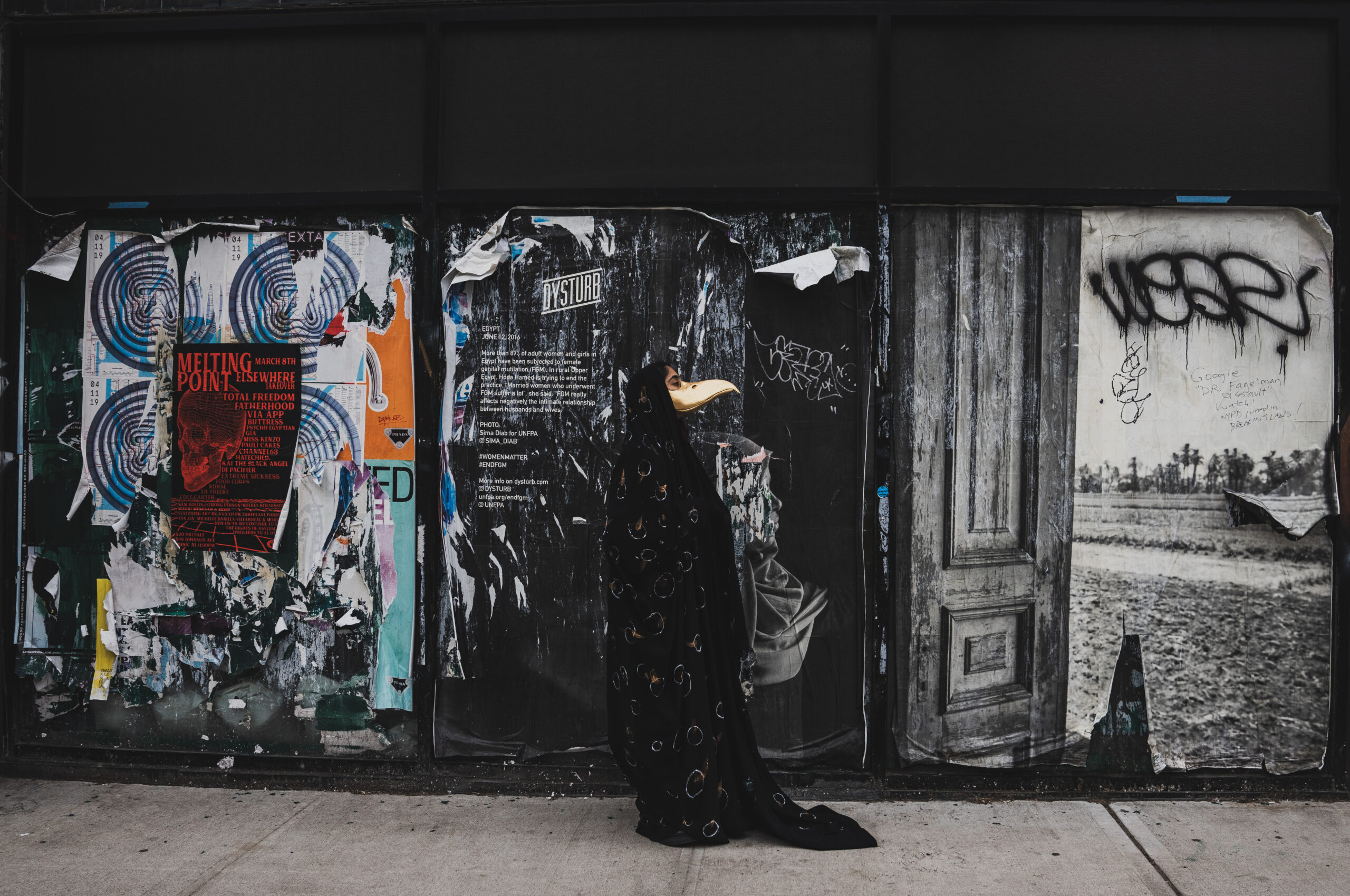
Qatari multidisciplinary artist Fatima Mohammed speaks to bayn/space about 3naj, her fictional alter ego whose hybrid identity—part American bald eagle, part Qatari batoola—has become one of the most recognisable figures in contemporary art from Qatar. With a rich practice spanning painting, sculpture, printmaking, photography, and performance, Mohammed’s work draws extensively from archival research to document Qatar’s social and economic transformation across generations, from the pre-oil era to the present day.

You studied painting and printmaking at VCU Qatar. Could you tell us more about your path of becoming an artist?
Fatima Mohammed: My artistic journey began with my grandmother, who was an art teacher in Qatar in the mid-1950s. As a child I would draw with her. I really looked up to her and wanted to follow her footsteps. Throughout the years art naturally became my way of expressing myself.
During my undergraduate, I was drawn to painting, printmaking, and storytelling specifically.
My professors, Michael Perrone and Fleming, played an important role in refining and shaping my art by challenging me while also giving me the freedom to explore different methods of expression.
During my third year of university in painting class my character, 3naj, was born. For me 3naj became a way to express identity, memory and the social transformations through history in Qatar and the GCC countries.

Your practice spans across painting, sculpture, printmaking, photography, and performance. How has your use of different media evolved throughout the years?
Fatima Mohammed: In my early works I started exploring painting and etching, but after a while I felt that my character, 3naj, could not be contained within a single form or confined to a flat surface. Sculpture gave her a body, photography allowed her to exist in real space and move through the world, and performance pushed her even further. Suddenly, 3naj was no longer just an image, she became a presence.
I worked with mixed media and installation; I also have created my own homemade inks using medicines prescribed to treat my back condition.
For me, the medium always follows the meaning. I ask what a work needs in order to become fully itself, and how it can find its own form.
This character, 3naj, is at the very heart of your work. How did this character develop over time? To what extent is she self-refential or an alter ego?
Fatima Mohammed: 3naj is half American bull eagle half Arab. Her beak is a combination of the American bolded eagle and the traditional batoola. Both are symbol of strength in the two cultures.
Back in the days in Qatar the batoola used to symbolise the strong women role and the mother in the household that everyone in the family respects.
3naj’s role during my university years was a way of navigating questions around identity, belonging, and cultural hybridity. Over time, she developed into a fictional alter ego through which I could examine both personal and collective experiences. She is definitely self-referential and she exists somewhere between fiction and autobiography. Through her I can explore more of my Qatari culture, the social and economical transformation that my country went through.

3naj’s perhaps most striking visual attribute is the beak which you have also introduced as a singular element in your sculptural work (The Pink, 2021; Speak Now, 2021) as well as a reference in many of your paintings. Could you tell us more about the importance of this symbol?
Fatima Mohammed: The beak became one of the most important symbols in my work because it gives the figure of a hybrid hard-to-place identity. It brings together the image of the American bald eagle and the batoola together which connects different cultural references in a single form. For me it reflects power, confidence, and social standards all at once.
Thematically your work has particularly looked at petro-culture and petro-colonialism in the context of Qatar and the GCC. Could you tell us more about these?
Fatima Mohammed: My work reflects how oil discovery in Qatar transformed not only the economies of this country but also its social structures.
A lot of Qatari families work in the petroleum industry; the people of Qatar contributed to developing this country. The economic shift that this country witnessed affected the people of this land specially. They went through a lot of difficult times to help built this nation. it’s important for me to document their role and show what the hard work of our grandparents.

Thematically you have also explored Qatari heritage, for example in the works of To be or not be (2021) Hello (2022), and The Start (2018). Could you share more of your thoughts concerning portraying heritage-related topics as a contemporary artist?
Fatima Mohammed: These are actually among my favourite paintings. The Start is based on a photograph of my grandmother, father, and uncle taken in the 1950s, at a time when Qatar was beginning to change. For me, the work speaks to family, unity, and the presence of a strong female figure who protects and holds the family together.
To Be or Not to Be shows a woman preparing traditional Laban, a practice got replaced by factory nowadays and deserves to be documented.
Hello is a painting of me with a camel, and it reflects the connection between human and animal life that has long been part of the Qatar history and environment.
In my work, heritage often appears through symbols, clothing, gestures and everyday references.
For me, contemporary art creates space for artist to engage with their heritage identity.

Your father is a historian and much of your work draws from extensive archival research, could you tell us more about this?
Fatima Mohammed: I come from a family of academics. At home my father would always talk about history and always encouraged us to read and conduct our own research.
Both of my parents have always pushed us to have our own archival records and books. That helped me shape my artistic practice a lot.
In 2021 you presented two series featuring photographic self-portraits presenting 3naj. What was the intention behind these series?
Fatima Mohammed: For me, photography became a way of documenting my performances. Through these images, 3naj becomes both observer and participant, moving through the space and trying to make sense of her surroundings.
The works also explore visibility and anonymity. Although I am physically present in the photographs, the costume and beak transform me into someone else entirely.

Particularly your paintings are known for a bright, colourful palette. How did these aesthetics come about and why do you continue to engage with such vibrant colours?
Fatima Mohammed: A vibrant colour palette brings joy and a sense of playfulness to subjects that can often be quite serious. Because I frequently work with archival images and documents, which are often stripped of colour and immediacy, these bright tones allow me to reanimate them and place them in a new emotional and visual register. In a way, colour brings them to life.
I also think colour allows me to build fictional worlds around 3naj that feel surreal, theatrical, and emotionally charged at the same time.
You have also recently started to experiment with neon light. What is it about this medium that interests you?
Fatima Mohammed: Yes indeed, I have recently started experimenting with neon light and signage. What interests me about neon is that it exists somewhere between language, advertisement, spectacle, and memory. It also introduces a playful dimension to the work, creating a stronger sense of interaction with the viewer.
Part of what first drew me to neon was seeing shop signs around the country and noticing how they shape the visual character of urban space.
What are you working on at the moment?
Fatima Mohammed: At the moment, I am working on a couple of different bodies of work. One looks at the current gas and economic crisis and the way it is affecting the world, while the other explores light, colour, and pop culture in a more playful way.

See Fatima Mohammed’s website here and follow her on Instagram here.
You might also like:
On Reconstructing Landscapes: Mubarak Al-Thani