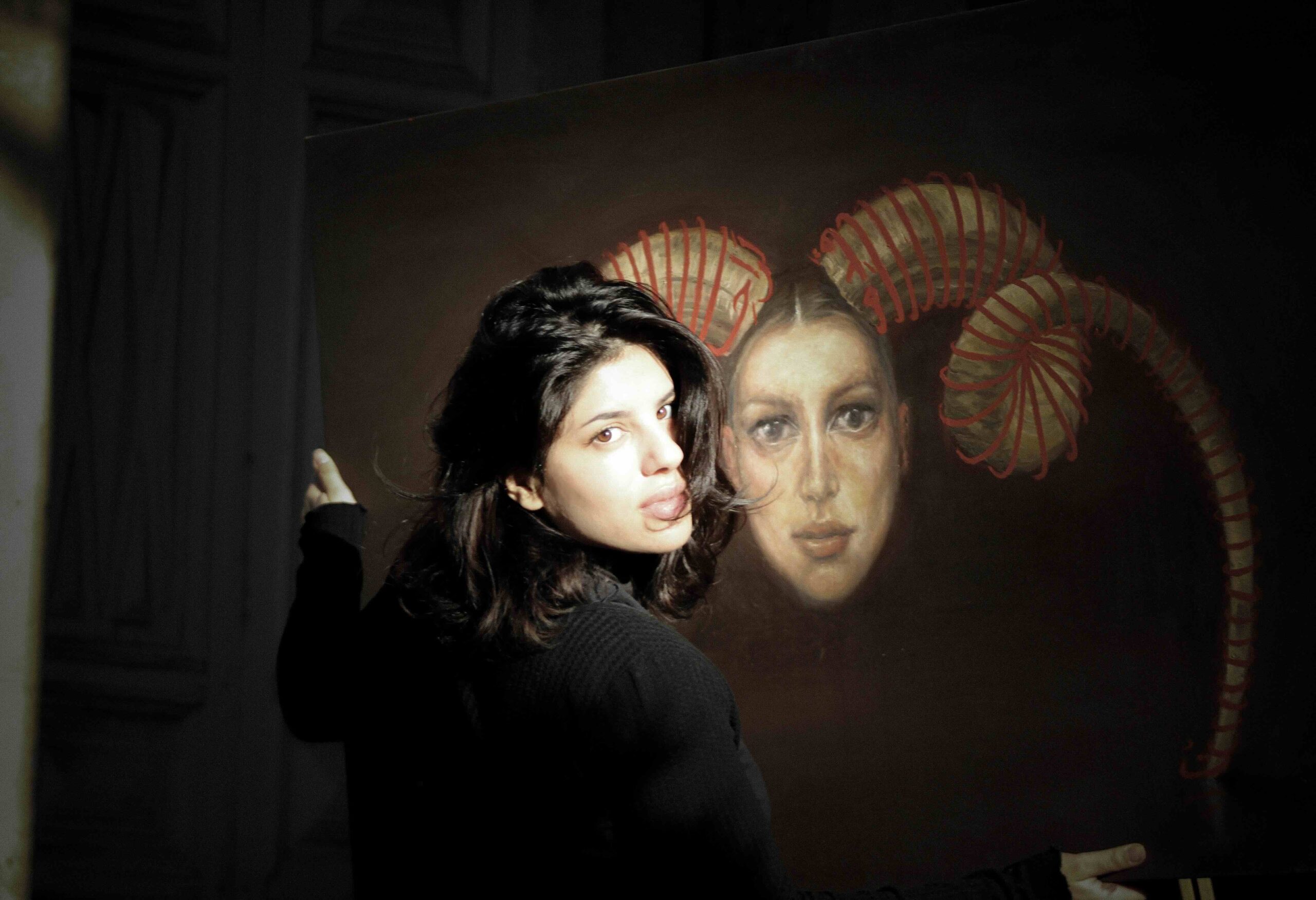
Jordanian-Palestinian painter Maha AbuMailesh, based in Amman, speaks to bayn/space about the relationship between human beings and the earth, the quiet resilience rooted in origins, and the feeling of belonging to a homeland she has never seen. Working between surrealism and dream-like realism, she translates internal states, questions of identity, displacement, and interconnectedness, into a visual language drawn from the colours of soil, landscape, and the human body.

You are a Jordanian-Palestinian artist based in Amman. Could you tell us about your decision to pursue a career in the fine arts? Where did you study?
Maha AbuMailesh: I feel that art was never really a choice for me but something I was born with. In many ways, I believe art chose me before I chose it. From the age of two, drawing and creating became a natural part of who I am, almost like a language I instinctively understood.
The environment I grew up in, the experiences I lived through, and everything surrounding me deeply influenced the way I express myself and the subjects I explore in my work. My identity, memories, and everyday observations continue to shape my artistic voice and the narratives I choose to present.
Studying fine arts at the University of Jordan felt like the most natural step for me. I never consciously planned a specific path or imagined a conventional career trajectory — the path somehow revealed itself over time, and I simply followed where it led me. Art has always been an inseparable part of my life and the foundation through which I understand and communicate with the world.
Your work diverges into the concept of social psychology that reflects on the ideology of human beings and their relation to the earth. Why is this such an important topic for you to explore through art?
Maha AbuMailesh: Most of my paintings are responses to questions and personal contemplations. Through my work, I reflect on the relationship between human beings and the earth — not only as a place we live on, but almost as a physical extension of the body itself.
I believe that everything is interconnected. Generations are connected to one another, just as we are connected to the trees we eat from and the environments we exist within. There is a powerful physical relationship between humans and nature, where every element becomes part of a larger whole.
For me, this interconnectedness is a way of expressing the feeling of belonging. Art allows me to explore how humans exist within this larger system and how our connection to the earth shapes our sense of identity, presence, and continuity.

People and their behaviour are at the centre of your work as you explore socio-physiological and political dilemmas regarding human interactions, identity, roots, and religion. How has your work evolved thematically in the last few years?
Maha AbuMailesh: Over the last few years, my work has evolved around the idea that much of what we live through socially and politically resembles a play. From the highest positions of power to the most ordinary roles in society, everyone becomes part of this larger structure that shapes human behavior and interaction.
In my practice, it became very important for me to express the voice of the people from the perspective of the people themselves. I’m less interested in presenting the final outcome, and more interested in questioning the reasons and systems that lead to these outcomes in the first place.
As societies, we often focus only on the ending of the play, the visible result, without going back to the deeper causes behind it. Through my work, I try to reflect on these hidden dynamics and explore the human condition within social and political realities.
You have also noted that the feeling of disconnectedness from your homeland, Palestine, plays a role in your artistic practice. Could you elaborate on this further?
Maha AbuMailesh: I always used to ask myself how I belong to a country I have never seen or lived in, yet I know I am from it and carry it within me through everything I hear and know about it. This question has always stayed with me and shaped the way I think about identity and belonging.
Stylistically your practice establishes a dialogue between surrealism and dream-like realism as you work through your subconscious. Could you tell us more about the aesthetic considerations within your practice?
Maha AbuMailesh: Aesthetically, my practice often moves between surrealism and a dream-like sense of realism, but this is not a deliberate stylistic choice as much as it is a reflection of how I process thoughts and emotions. I am interested in how the subconscious can translate into visual language: how internal questions, tensions, and perceptions can appear in forms that feel both familiar and slightly displaced.
I don’t aim to create a strict separation between reality and imagination. Instead, I try to allow them to coexist on the same surface. This creates a space where forms, figures, and symbols can feel real, yet not entirely fixed in reality; as if they are in a state between thought and experience.

Your first solo exhibition Qadimto(‘I Came’) discussed the quiet resilience that resides within us all, deeply rooted in our origins and the natural world. Could you tell us more about the process that led to your first show and the subsequent moments? After all, an artist’s first solo exhibition marks a rite of passage.
Maha AbuMailesh: My first solo exhibition Qadimto (‘I Came’) was a very important and transformative moment in my practice. The process leading up to it was not something I approached as a formal milestone or a planned career step, but rather as a natural continuation of everything I had been exploring internally and artistically.
At that stage, I was deeply focused on ideas of resilience—not in a loud or heroic sense, but in a quiet, almost instinctive way that exists within human beings. I was interested in how this resilience is rooted in our origins, in our connection to the earth, and in the way we continue to exist and adapt through time and circumstance.
The works came out of a very intuitive process. I was not trying to illustrate a fixed concept, but rather to translate emotional and physical states that I felt were already present within me. There was a strong sense of return in the work—not necessarily to a place, but to something more essential and grounded.
After the exhibition, the experience shifted my understanding of my practice. It made me realise that once the work is shown, it no longer belongs only to me. It starts to exist in relation to others—to their interpretations, emotions, and readings. That moment marked a quiet but significant transition, where I began to understand my role less as someone who defines meaning, and more as someone who opens space for it to exist.

This body of work sits at a compelling interaction of surrealism and magical realism. Could you tell us more about developing such a dreamlike register?
Maha AbuMailesh: For me, this ‘dreamlike’ register is not something I consciously construct as a style, but rather a natural outcome of how I process reality. I do not separate what is real from what is imagined in a strict way—they constantly overlap in my thinking. That overlap is what creates this space that can feel close to surrealism and magical realism at the same time.
When I work, I am less interested in depicting a literal scene and more interested in translating internal states such as questions, emotions, and perceptions that do not always have a fixed visual form. The subconscious plays a big role in that. Images, symbols, and compositions often emerge in a fragmented way, and I allow them to stay open rather than forcing them into clarity.

The palette you present is also strikingly consistent: deep crimson and dark umber dominate, punctuated by occasional blue-grey and gold-ochre. Your use of red is not decorative as it functions symbolically, almost viscerally as blood, desire, entrapment, and life force simultaneously. What are your thoughts on the colours in these works?
Maha AbuMailesh: My palette is mainly inspired by the environment I live in and the natural tones that surround me. Most of the colours come from the earth itself, from landscapes, soil, organic textures, and also from the human body.
The only colour that appears more distinctly and intentionally is red. For me, red carries a very direct and physical meaning. It refers to blood, but also to the idea of roots—something deeply internal, essential, and tied to existence itself.
Overall, I see all the colours in my work as extensions of both the earth and the body. They are not used in a purely aesthetic or decorative way, but as a way to connect material reality with emotional experience, and to express how deeply everything is interconnected—nature, humans, and feeling.

What are you working on at the moment?
Maha AbuMailesh: At the moment, I am working on a continuation of my earlier series Qadimto. This new body of work is titled la rahelon “ لراحلٌ “ for departing.
In this series, I am exploring more experimental approaches in terms of material, colour, and surface. While it continues to build on the same conceptual foundations, I am more focused on pushing the physicality of the work and how different materials can shift its emotional and visual language.

See Maha AbuMailesh’s website here and follow her on Instagram here.
You might also like:
Amira Khalil: Painting Unapologetic Women