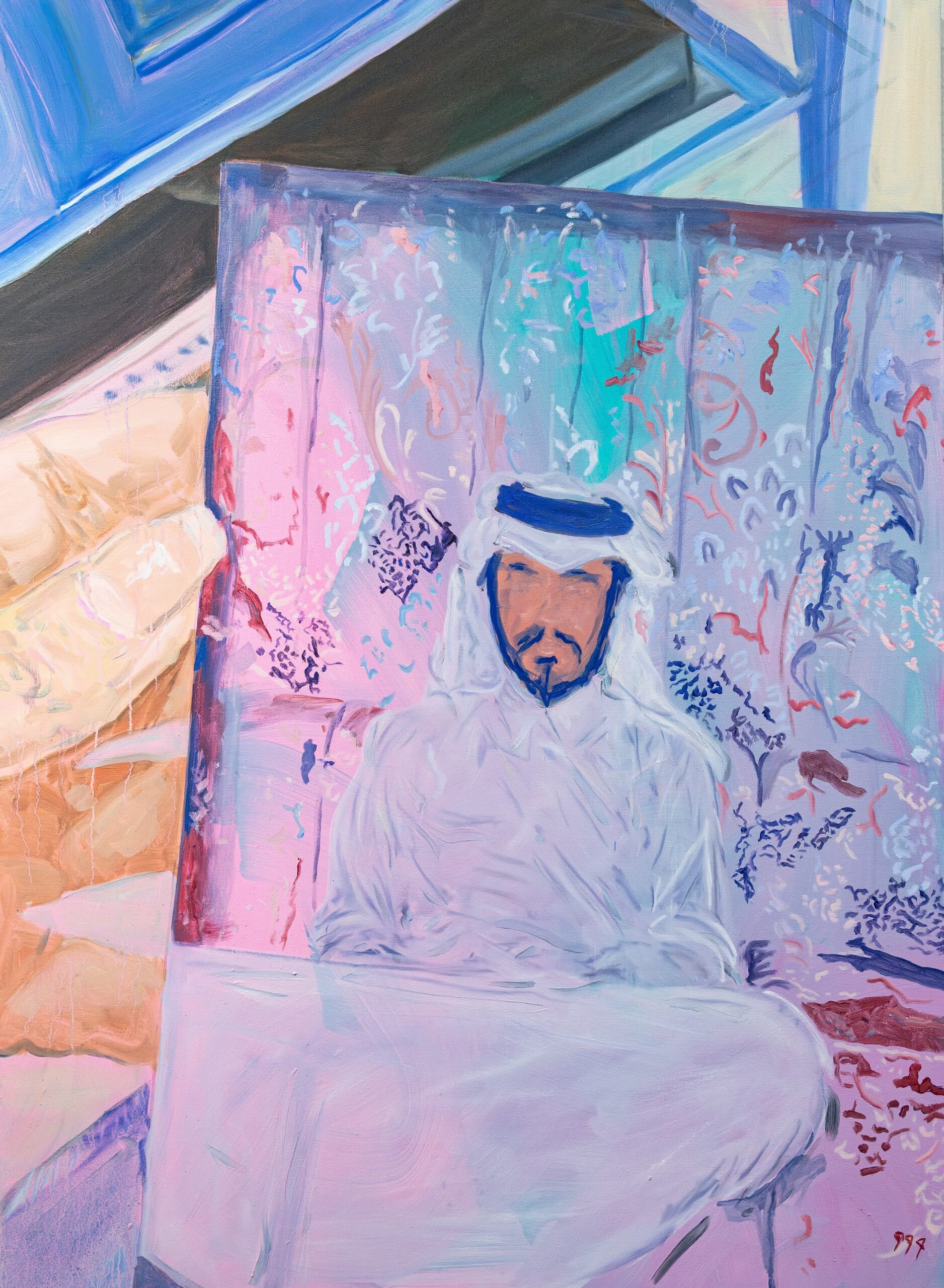
In this in-depth interview Qatari painter Hissa Al Kuwari (b. 2003) speaks to bayn/space about her first solo exhibition Al Sa’ala: What a Room Could Remember, organised by Sana Art at Katara Art Centre, on view until 7 October 2026. In this show she reflects on the cultural significance of the living room and the Thursday-night gatherings at her grandmother’s house that inspired it. Working from photographs taken over years of family life, she builds layered, sometimes deliberately unresolved compositions that treat the Khaleeji living room as an archive—a space that absorbs celebration, conflict, and the small rituals of the everyday, and quietly remembers them long after the room empties out.

You studied painting and printmaking at VCUarts Qatar. Was it an obvious choice for you to pursue a career in the arts?
Hissa Al Kuwari: After pursuing a high school degree in advanced sciences, I graduated high school with nothing in mind other than pursuing the arts. Although I had not taken an art class in the past three years, since I was focused on the sciences, nothing other than art made sense to me at the time. So that is what I did. I took the risk and only applied to one university, and that was VCUarts Qatar.
How was your experience at VCUarts Qatar? What did you particularly enjoy? Was there anything that you found challenging?
Hissa Al Kuwari: The four years I spent at VCU were some of the best of my life. I truly enjoyed every second of it. Classes, lectures, and assignments were such a joy to undertake, and I was curious and excited about everything the place had to offer. I especially loved sharing my studio during my time as a Painting and Printmaking major with five other amazing Qatari women artists. Our space was always exploding with projects, and I loved seeing how each one of us developed her own practice through the years. We would also have fruitful conversations and informal critique sessions, so I was really grateful to get to learn alongside them.
There were some challenging aspects, but they were also somehow the most fulfilling in a way. While pursuing a minor in Art History, I struggled with some of the terminology we would discuss through certain readings, especially since I had never had to study art through this lens in my entire twelve years of education. But when I got to my last semester at VCU, I found myself taking in every second of those Art History classes, just because of how much I felt they expanded my horizons. So, I really appreciate the chance I got to learn my way through the courses.

How has your work developed thematically over the years?
Hissa Al Kuwari: Surprisingly, I still feel very strongly about the same themes I approached even as a sophomore in university. I think even though we are in the digital age, and unlike ever before, we have exposure to the entire world, a part of me is still heavily influenced by the environment I am surrounded by. And I see all the details that make up what’s around me, such as houses, landscapes, fashion, trends, music, rituals, speech, and culture, as something huge that takes me a long time to understand, analyse, and make sense of.
From that, I started by looking at my all-girls high school and treating that space as its own world. I looked at the architecture and interior design of the space, and the dynamics that occurred within. I looked at our uniforms, I looked at the fashion trends that occurred when I was a student, and I also started discussing the rules we had, why they were there, and where they came from. There was, and still is, a thousand things to be said about a space like that, and I think that’s part of the reason why I still work with similar themes.

What do you think are your biggest challenges as an emerging artist?
Hissa Al Kuwari: I struggle with finding confidence. I find myself still struggling with moving away from being a student into an independent artist, and trusting that I know my work and how to approach it without outsourcing this validation.

You are one of the current residents at the Fire Station programme under Wael Shawky. Could you tell us more about your experiences during this residency? How has the programme affected your practice?
Hissa Al Kuwari: My experience has been beyond amazing. I have learned more than I ever imagined I would, and I have had the opportunity to meet so many amazing minds from all over the globe. Being surrounded by people with such different backgrounds and practices has really helped me see my own work through different perspectives.
I also feel that the program has pushed me to challenge myself more. I found myself branching out into new mediums that I had not tried before, and the residency gave me the space and support to experiment, take risks, and continue learning. I think that sense of freedom to explore has had a really meaningful impact on my practice.

Your current solo show Al Sa’ala: What a Room Could Remember organised by Sana Art at Katara Art Centre focuses on the cultural significance of the living room in the Khaleeji context. Could you tell us more about the backstory of this exhibition?
Hissa Al Kuwari: The exhibition was inspired by the multiple weekly family gatherings we have, and for this particular show, I was looking closely at the Thursday evening gathering we have at my grandparents’ house, where my aunts, uncles, and cousins all come together. It is always such an explosive couple of hours. Kids are running in circles, voices and conversations create a symphony, rising and lowering depending on the excitement, tea and coffee pots keep getting refilled, and the tea cups are constantly being passed around. The younger girl cousins sit and chat, while the boy cousins play a board game in the corner.
I just felt so positively overwhelmed by being in that space. I started taking photographs of certain moments that I found interesting, such as the photograph that inspired my painting Accumulation. In it, my cousin has covered her face to take a nap at the end of the night while waiting for her family to leave, surrounded by what seems like mountains and mountains of tea boxes, coffee pots, dates, biscuits, and fruit.
I chose what I found to be the most compelling photographs I took, while still respecting the privacy of a space like this. Through my color palette and brushstrokes, I wanted to exaggerate these moments further, creating compositions that are very layered and, in some cases, disconnected. I wanted to leave some of these scenes open ended, asking the viewer to use their own imagination to continue the scene.

How did the body of work you present in this show develop?
Hissa Al Kuwari: I first went through my camera roll and created a folder of any photos I had taken in living rooms over the years. Once I started working on my painting Accumulation, I chose to stick to that one space, that one living room, and through the body of work, rebuild moments that had occurred there over time.
What does the living room mean to you?
Hissa Al Kuwari: The living room, to me, is so many things at once. It is a place of confrontation, where clashes, disagreements, and awkward encounters happen between family members at the end of the week. But it is also a metaphorical bulletin board for news, where people make announcements, share updates, and pass around stories.
It is a space of celebration, too, where countless candles have been blown out, cakes have been cut, and thousands of songs have been blasted through the speaker. It holds so many different versions of the same people, sometimes all within the span of a few hours. I think that is what makes the living room so interesting to me. It is an ordinary space, but it quietly witnesses so much of our lives. It absorbs the conversations, rituals, celebrations, tensions, and small everyday moments that we often do not think twice about, and somehow all of that becomes part of what the room remembers.

Your grandmother’s living room plays a particular significance for you. Could you tell us more about the process of painting something that is very close to your heart?
Hissa Al Kuwari: Her living room has been one of my favourite places ever since I was a little girl, so it was really special to get to honor that space through my paintings. I found the process to be very intuitive, to be honest. Most of the time, while painting, I had the details memorised and did not need to look at my reference. I think because I have spent so much time in that room, I had a very strong visual and emotional memory of it.
That made the process feel almost effortless at times. It felt less like I was trying to recreate the room exactly, and more like I was painting my memory of it.

It seems that nostalgia is a dear concept to you. Could you further characterise this relationship?
Hissa Al Kuwari: I find myself always feeling nostalgic for different spaces from my childhood, not just living rooms, but also malls, restaurants, coffee shops, parks, and other places that were part of my everyday life. I remember playing with my cousins, having parties, playing hide-and-seek, going to the mall, or spending afternoons at a particular restaurant or coffee shop. So many of these places hold very specific memories for me, and I think a lot of my nostalgia is tied to the spaces themselves.
Many of these places are not as I remember them anymore. Some have been demolished or replaced, while others have gone through renovations to reflect current interior design trends. I think it is really interesting to think about the process of trying to remember these spaces as they were, especially when the physical space no longer exists in the same way. Digital photographs and family albums play a great part in conserving these memories, almost preserving the space within their borders. For me, nostalgia becomes a way of revisiting these places and trying to understand what they meant to me, beyond just what they physically looked like.

What themes are you working with currently?
Hissa Al Kuwari: Through the Fire Station’s Arts Intensive Study Program, I am working with similar themes of domestic settings and women’s spaces, but through a new medium for me. I have been working with and creating fabric dolls of varying sizes, and exploring what it means for them to represent a space, hold memories, and tell a story.
What I have really enjoyed is that, despite working with a new medium, I still have the same sense of play that I have in my paintings. I am still collecting patterns, creating colour palettes, and experimenting with different combinations. It has been a really fun way to explore these familiar themes while allowing myself to be playful and experiment with the medium.
How do you feel right after the first solo exhibition of your life?
Hissa Al Kuwari: It felt so unreal and exciting to see all my paintings on the gallery walls, and it felt even more unreal when I saw my name on the wall text. There is something very special about seeing work that has lived with you for so long to suddenly exist in a public space, where other people can experience it and form their own connections with it.
I am very grateful for this experience and for everyone who was a part of it, and I am excited to see what connections people will create with the work. I think that is one of the most exciting parts of having the exhibition out in the world now, getting to see how other people interpret and respond to something that started from such a personal place.

More on Hissa Al Kuwari here. Her solo show Al Sa’ala: What a Room Could Remember is on view until 7 October 2026 at Katara Art Centre organised by Sana Art.
Reply