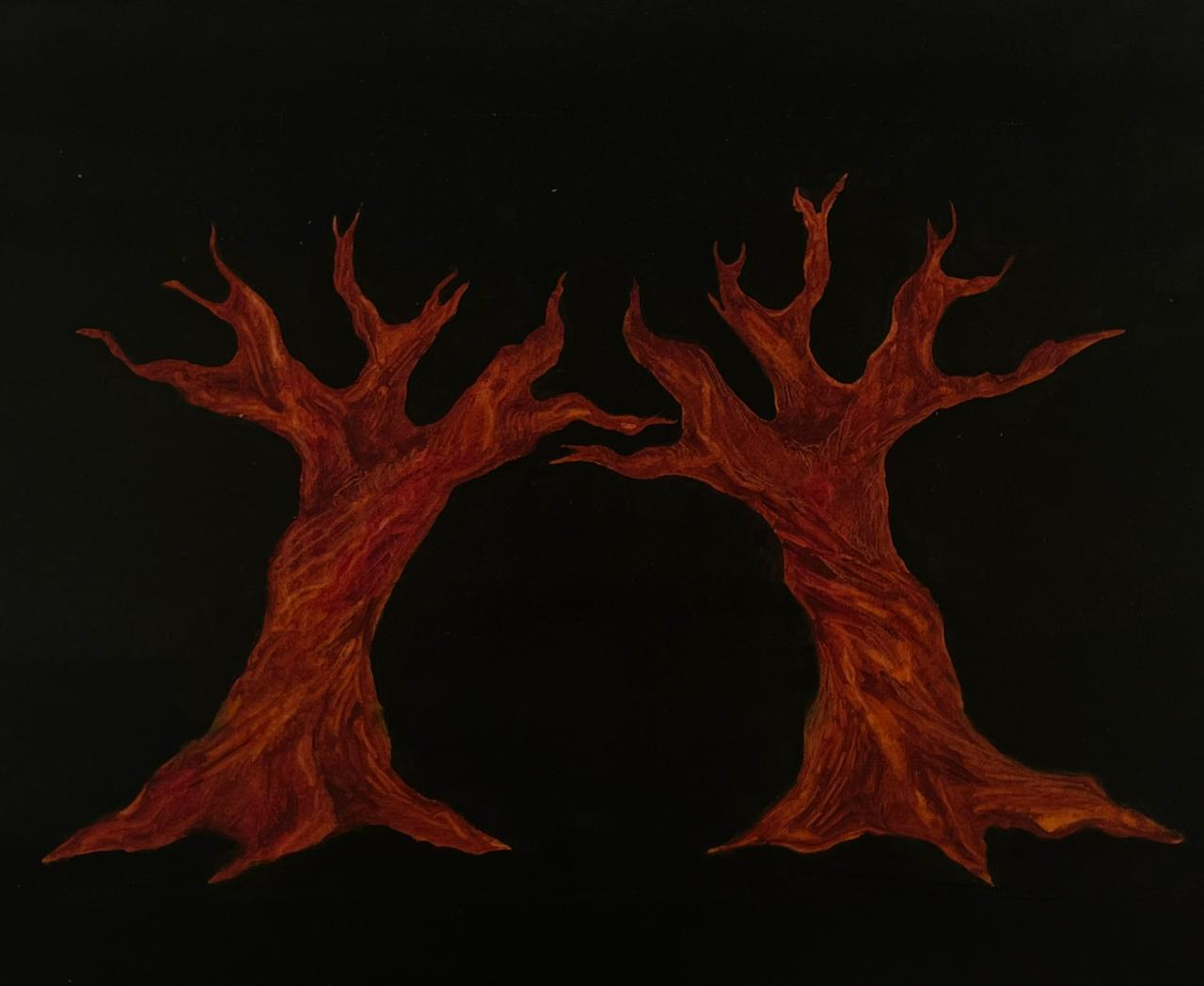
Painter Husna Samer (b. 2005) speaks to bayn/space about home as a condition rather than a place, the pull between remembering and forgetting, and a practice increasingly shaped by the sense that life unfolds as a spiral rather than a line. Drawing on myth, culture, and Sufi thought, she builds a visual language rooted in surrealism, where red and blue—one active and outward-facing, the other internal and slow—trace a self that is always coming apart and reassembling.
Could you tell us more about your path of becoming an artist? Was pursuing a career in the fine arts an obvious choice for you?
Husna Samer: I have always made art in some form or the other growing up. Making art was a way for me to be actively curious instead of passively. It gave my hands something to do and discover. I owe a lot to my environment as well, my parents really encouraged my practice, asked questions and challenged me.
I was also exposed to a lot of artist mentors in my teenage years. I had the opportunity to observe their practice and in return they would observe mine. To witness how those practices were sustained and developed, both in terms of technique and theory, really helped me shape my own taste.
Pursuing a career in the fine arts was not something I had planned out but it was inevitable. I am double majoring in a completely different area of study now but also very grateful to be able to pursue what sustains and nourishes my heart.

At the core of your practice you continue to explore the meaning of ‘home’. Why is this such an important topic for you?
Husna Samer: Home is not a physical space to me, it manifests in people, places and objects. Ironically, home for me is never static either, I do not allow myself to be confined (which is a type of confinement in itself). Stagnancy scares me, my practice allows me to document my ‘home’ as it transforms itself and me.
Questions related to identity and the sense of self are also at the forefront in your work. Why do you think you are drawn to these topics?
Husna Samer: Because I am unsure about everything, I do not believe in permanent states, everything is coming apart and being put together again – this excites me because there’s always something to unearth in regards to identity and the ‘self’.

How has your work developed thematically recently?
Husna Samer: With the coming back of older friends, revisiting physical locations from my memories years later, and feeling like I have taken ten steps back instead of one forward, it has pushed my work into a new more settled but also frantic direction. I have been forced to reckon with the coming of my life as a spiral. This has been a recurring idea on which my practice is currently centered upon. the state of constantly becoming.
Aesthetically your work is dominated by the hues of blues and reds. Could you tell us more about the meaning of colour in your work?
Husna Samer: Blue and red present themselves as the languages of the work, they dictate mood, feeling. This has always been a deliberate choice. They complement and contrast each other – evoke such opposite but also similar feelings. Red acts as an external color, its present, active and seeking. Blue is internal, passive and slow. There are moments where they assimilate in my work and moments when they’re on their own.

There is also an inclination towards symbolism and surrealism in your work as your paintings often suggest inner landscapes rather than depicting literal ones. Could you walk us through the development of your visual lexicon in relation to exploring meaning through symbols and subtle clues?
Husna Samer: I have always loved stories, especially ones that explored myths, history, religion and culture – I recognise that these are sensitive topics with sensitive imagery and my practice works to open up these ideas to the viewer. Myths, culture, history and religion are tied to each other, they are grandiose, ambitious, they have the power of persuasion, they draw us into other states of being.
These concepts are bigger than the individual but also closely linked and shaped by them. The inner work is what I want to explore through symbolism and surrealism. It acts as a reference point to worlds outside of my practice. The work I make then becomes an extension of an ongoing universal narrative.
Surrealism is tied closely to the way I perceive spirituality, the essence of faith as described in Sufi language comes to life through surrealism and personification as a visual lexicon. Its mysticism and (mizaan) or balance rooted in constant return and reiteration of the self allows these symbols, metaphors and notations to come into being.This ouroboros has birthed my
visual language that will forever evolve.

There are a number of dichotomies you are looking at in your work–remembering and forgetting; self and surrounding; permanence and change. Do you recognise these opposites and if so, what attracts you to them?
Husna Samer: I think there are always two sides to a story, yin and yang, blue pill/red pill. Everything has a complement, another face. This half and half intrigues me, I want to play with that defining line.
Remembering and forgetting are inextricably linked to memory, it fuels bias, self and surrounding take from one another. These concepts are wired into the way life unfolds – I want to play with that idea quite literally.
How does the artworld look like for you in the perspective of an emerging artist? What kind of career aspirations do you have?
Husna Samer: The artworld is always changing, it’s almost always a reflection or reaction to society as it evolves. Knowing this, it makes it easier to make the work. To allow myself the relief of knowing my practice has its own life and will take its own course instead of worrying and forcing it to go in a certain direction. This is the most important thing as I move forward in my career, the belief that the work will come into being when and how it needs to.

More on Husna Samer here. Follow her on Instagram here.
You might also like:
Huda Jamal: Between Structure and Memory
Reply