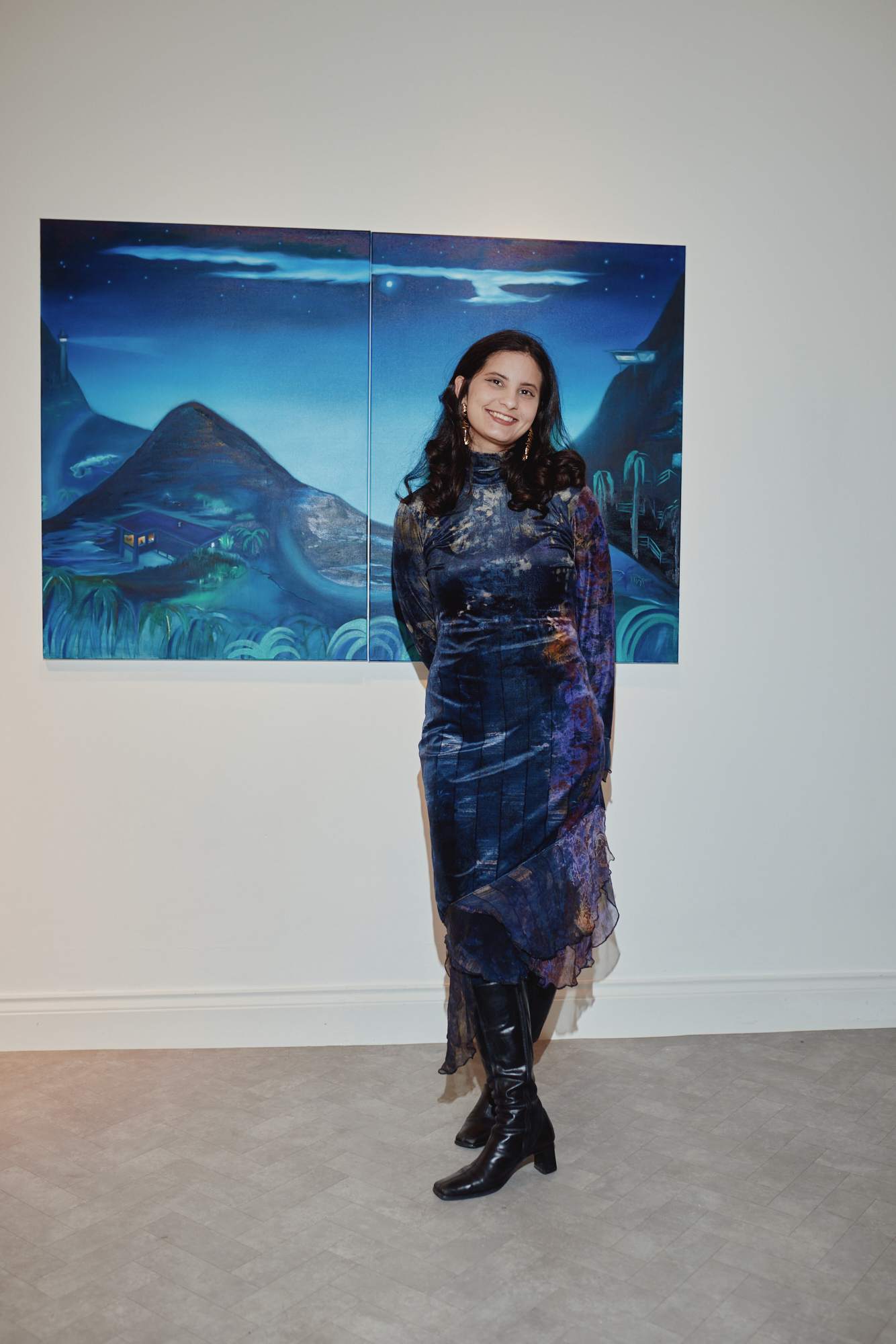
Tunisian painter Myriame Dachraoui turned to painting during the COVID-19 lockdown, a period of isolation that became the unexpected catalyst for her practice. She speaks to bayn/space about the spatial instincts she carries from her architectural training, the mythology she has built around her grandmother, and her relationship with the azure coast of Carthage that runs through everything she makes.

You trained as an architect at the École Nationale d’Architecture et d’Urbanisme in Tunis and became a self-taught painter. How did you navigate this transition? How do you think your background as an architect manifests in your artistic practice?
After architecture school, I worked for a few years in the field, but during that time, something was missing within me. During Covid lockdown, I had a difficult experience with loneliness. It was brutal and very hard to express. This is when I started making digital paintings. Suddenly, it felt as if the missing piece was there, in the immense infinity of possibilities that painting was offering me.
Architecture school is probably the best training a creative person can get. It opens your mind and helps you understand how structures work. It also gives you a sense of composition, an instinct for it, and I think this is what I bring to my painting today. Beyond the spatial representations in my work there is this natural instinct for how to compose a canvas and I think it comes from my years of architectural training.

Architecture teaches us to think in sections, to cut through a building and reveal its interior logic. Your paintings seem to do something similar with the psyche, exposing inner states through spatial compositions. How consciously do you apply architectural thinking when you construct a canvas? Is the process closer to designing a room or to inhabiting one?
As I said previously, I carry a strong sense of composition from my training in architecture, so in a way, I might think like an architect when I draw a room or another kind of space. Not because I am trying to make the space beautiful or well-designed, but more because I am searching for balance between openings, heights, and inside-outside proportions.
Today, though, I do it without really thinking about it. It is probably due to years of drawing plans, façades, and sections, which allow my hand and brain to operate in a more instinctive way. The spaces I represent are more projections of my inner psyche and interior world.

You have spoken about how the pandemic became the catalyst for your painting practice, as this period of anxiety and isolation turned you towards the canvas. Could you tell us more about your early explorations with painting?
When I was a student, I painted quite rarely and didn’t really consider a career in art. During my studies, I would occasionally take on small artistic projects and work on films. I found myself collaborating several times on the animated films of director Nadia Rais, who, in her earlier works, created every frame by hand using dry pastel. I worked as a colourist with her, so we would spend months working on 3,000 frames entirely by hand, using pastel and charcoal.
I think this first experience made me very happy, and I realised that I had a natural ease when working with materials, as it reminded me of acrylic painting.
A couple of years before that experience, I took some painting classes, nothing very formal, just to prepare for my entrance exams to architecture school. This is also when I spent a lot of time studying Matisse. I think the fact that I started directly with a Fauvist painter instead of taking more classical courses first helped me develop a strong relationship with colour. Very early on, I understood that colour is the core of a painting for me, how you compose it and how you make it vibrate.

The colour blue saturates your practice. Not necessarily as melancholy, as you have said, but as a frequency of sensitivity, of late-night thought and remembered worlds. Yet your more recent works introduce warmer, more volatile tones. What has shifted?
I am actually working on a blue piece at the moment. This colour will always be present in my work. But recently, I have introduced a more earthy palette into my paintings.
This came from the conclusion that I wanted a richer and more complex palette. Although I am fundamentally attracted to blue, I felt I needed to step away from it for a while in order to come back to it with a more trained eye. It is a way of training myself to explore other colour combinations, to understand how different colours interact, and how I can create a vibrant landscape using less “electric” colours and only shades of sienna and yellow, for example.

Your figures are typically static and contemplative, positioned in interiors or at thresholds, disconnected from immediate reality—yet they do not feel passive. There is a quality of suspended attention in them, as if they are listening to something just outside the frame. Who are the people you paint?
The figures I represent most often are feminine and often in a contemplative state. Usually, they are representations of myself or my grandmother, whom I use as a matriarchal figure, but also as a character who crystallises my family history: my mother, myself, and the women around me.
There is a mythology that I have developed around my grandmother. My studio is full of photographs of her, and yet I never represented her accurately.

What are the main themes you explore in your work? How have those changed in recent years?
My work revolves around femininity, family stories, local myths, and secrecy. There is something mystical about growing up on the azure coast of Tunis. It is a place that holds so much history, so many ways of living, superstitions, sensuality and taboos. I guess this complexity and contradiction is where I draw most of my inspiration.
Sometimes I spend more time exploring a particular theme because I feel the need to document it and understand it better, as has been the case recently with family history, where I have worked extensively with photographic archives.
The Mediterranean plays a huge role in your work. Could you tell us more about your relationship with your native Tunisia, its influence on your work, and your relationship with the Mediterranean?
As I mentioned before, it is not only the Mediterranean but specifically the coast of Tunis, which was once Carthage, the greatest trading port on earth before its downfall; where Aeneas and Elissa fell in love. There is a strong energy here, something quite ethereal, I would say. When you look at the sea and think about all the civilisations that crossed it, settled in Carthage, and left traces behind, you realise that every culture contributed to who we are today. In my work, I allow myself to freely use all the symbolism that is present in our lives, Arab Muslim, Ottoman, Phoenician, Amazigh, and many others.

Symbolism and recurring visual motifs are also at the heart of your work. Could you tell us more about your process of constructing a personal iconography through your paintings?
Tunisian artists very often use their heritage to create a language and build a bridge between history and their work. For example, I recently used the famous Mask of Carthage, which was used by the Phoenicians as a protective symbol, as well as the myth of El Ghoula, to create my own monster figure.
In a small series that has not yet been exhibited, El Ghoula appears as a shadow and as a representation of the process of emancipating my female characters from some of the taboos they live with.


What are you working on at the moment?
I recently worked on a short series called El Ghoula, where I took some distance from my usual palette and themes in order to explore taboos surrounding the body and Tunisian folklore.
Now I am back to something more familiar and am developing a series around scenes of Tunis, something more directly inspired by my life here and less fictional. I will be working on a larger body of work for several upcoming projects next year.

The portrait of Myriame Dachraoui is courtesy of Gallery 44.
See more about Myriame Dachraoui here and here. Follow her on Instagram here.
Reply