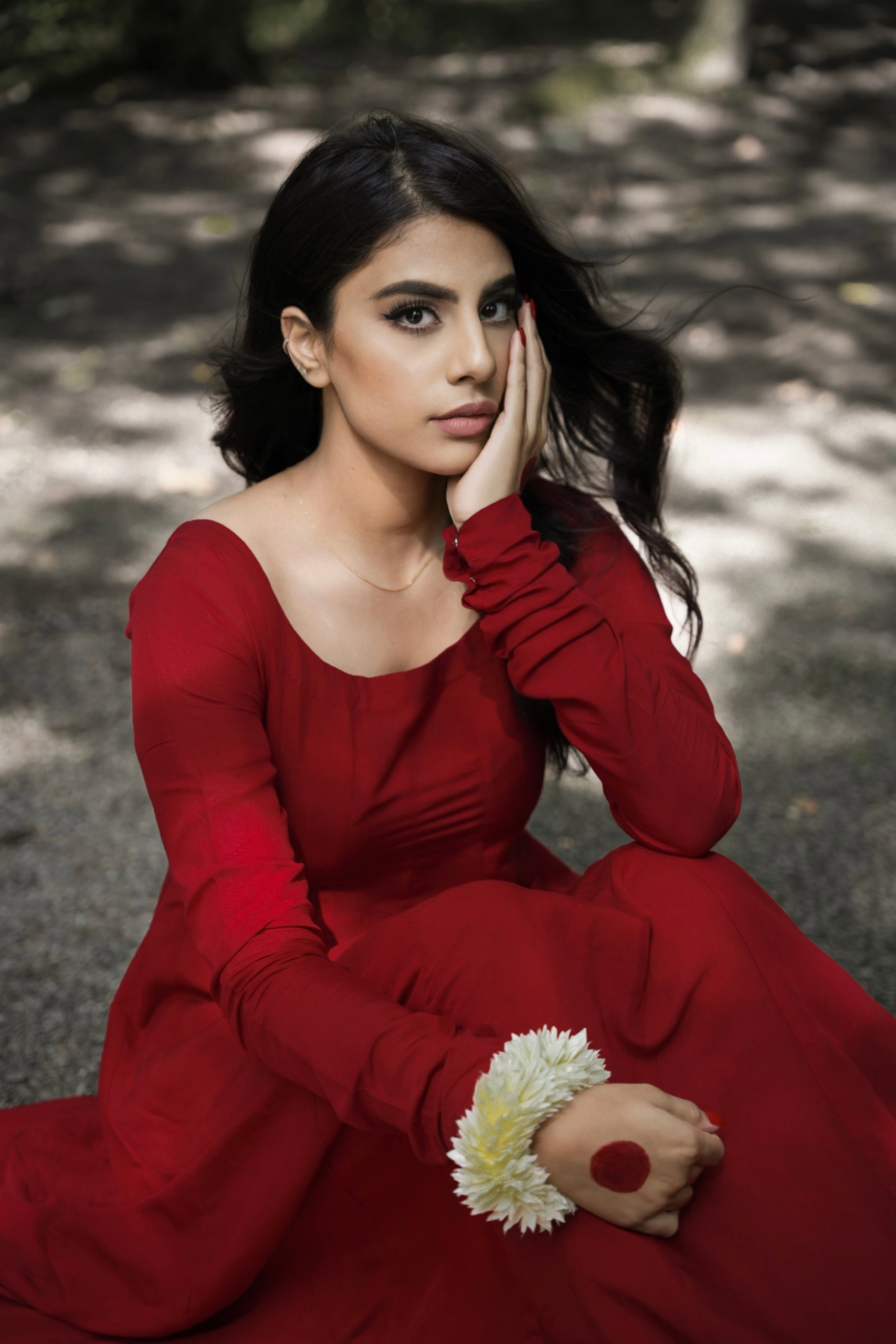
Pakistani painter Mahnoor Salman Khan, based between Lahore and Manchester, speaks to bayn/space about love as both subject and spiritual conviction as well as the lush, meditative landscapes through which she explores it. Trained in Miniature Painting at the National College of Arts in Lahore and Fine Art at Manchester Metropolitan University, Khan weaves traditional South Asian miniature techniques with a deeply personal and devotional sensibility, in which nature becomes the purest expression of divine care. Her paintings, intricate gardens, flowering branches, figures held within greenery, invite stillness, and ask viewers to look at the world around them with a little more tenderness.

You studied Miniature Painting at the National College of Arts, Lahore, and Fine Artat the Manchester Metropolitan University. Could you tell us more about your path of becoming an artist? Was pursuing a career in the fine arts an obvious choice for you?
Mahnoor Salman Khan: I think becoming an artist was always a natural path for me. I’ve always had a strong inclination towards art from a very young age. Over time, that interest only grew stronger, and I realised this was what I wanted to do in life. Pursuing arts felt like the most natural choice for me rather than a difficult decision. I’ve also been very fortunate to have parents who supported me throughout my journey. Their encouragement gave me the confidence to pursue art seriously, first through studying Miniature Painting at the National College of Arts in Lahore and later Fine Art at Manchester Metropolitan University. Each stage helped shape my practice, but the desire to become an artist was something I always carried with me from childhood.
Having studied both in Lahore and Manchester, how would you compare the two schools and the education they provided you with?
Mahnoor Salman Khan: In many ways, both experiences were quite similar. At both universities, the teachers constantly encouraged us to explore, question and push our practice further. They gave us the freedom to experiment while also being very supportive throughout that process which I found incredibly valuable as an artist.
At the National College of Arts, there was a dedicated department for Miniature Painting, so naturally there was a deep understanding of the technique, history and discipline behind the practice. Being in that environment gave me a very strong foundation and allowed me to engage closely with the tradition.
At Manchester Metropolitan University, the context was different, but equally enriching. While miniature painting was less familiar there as a discipline, there was a real openness and curiosity towards my work. My tutors genuinely appreciated what I was doing and made an effort to understand the ideas, history and cultural background behind it. That exchange was really important for me because it allowed me to place my practice in dialogue with a wider contemporary art context.

Could you also tell us more about your initial decision of studying Miniature Painting? There is such a rich tradition and celebrated legacy starting with the 16thcentury Mughal and Persian manuscript traditions in Pakistan with regards to this movement.
Mahnoor Salman Khan: My decision to study Miniature Painting really began with curiosity. I wanted to learn something completely new, something I had no previous knowledge of. Before joining the program, I honestly knew very little about miniature painting. I had never practiced it before and didn’t fully understand the depth of its history or technique. But once I started learning, I found myself drawn deeper and deeper into it.
As I continued studying, I became increasingly aware of the rich history behind the tradition, especially its connection to the 16th-century Mughal and Persian traditions. Learning that miniature painting carries such an important visual and cultural legacy in South Asia made the experience even more meaningful for me. I was fascinated by how these works combined storytelling, craftsmanship, observation and symbolism with such delicacy and precision. What interested me even more was how the tradition continues to evolve in contemporary practice. While it is rooted in history, it also offers so much space for reinterpretation and experimentation in the present. That balance between tradition and contemporary expression is something I found incredibly powerful and it’s what continues to draw me to the medium.

In your practice you weave traditional South Asian miniature techniques with a contemporary sensibility, rooted in the belief that nature is a love letter from God, and a quiet, enduring expression of care. Could you tell us more about your contemporary practice in relation to the historical art movement?
Mahnoor Salman Khan: Historically, miniature painting held a very intimate relationship with nature. In the 16th century, the Mughal Era, the paintings especially, flowers, gardens, animals and landscapes were rendered with incredible care and precision. Nature was not simply background; it often carried symbolism, emotion and meaning. That relationship is something I feel very connected to in my own work.
In my practice, I use the traditional techniques and visual language of miniature painting but I reinterpret them through a contemporary and personal lens. Rather than illustrating court scenes or manuscripts, I create spaces that feel emotional, reflective and rooted in the present. I’m interested in continuing the dialogue that miniature painting has always had with beauty, symbolism and close looking, while shifting its meaning into a contemporary context.
For me, nature becomes both subject and metaphor, a reflection of divine care, presence and love. In that way, my work feels connected to the historical movement while also allowing space for my own experiences and perspective within it.

How did you become interested in miniature painting in the first place?
Mahnoor Salman Khan: My interest in miniature painting really began during my first year at the National College of Arts. I remember walking through the studios and seeing senior students working on miniature paintings and I was immediately intrigued by it. I had never seen anything like it up close before; the level of skill, precision and patience it required was fascinating to me. The more I observed it, the more curious I became to understand how it was made and what histories it carried. That curiosity is what led me into studying it more seriously, and once I began learning the process myself, I became deeply connected to it.
Who are your personal favourite miniature artists?
Mahnoor Salman Khan: Imran Qureshi, Waqas Khan, Wardha Shabbir, Mobeen Akhtar.

What are the main themes you explore you in your work and how have those evolved in the past years?
Mahnoor Salman Khan: Love has always been the central theme in my work and I think it has evolved naturally over time. Earlier in my practice, especially during college, I explored love in a very personal and intimate way. I used to paint love letters and dried roses because I was interested in preserving the emotions they carried. I was drawn to how these objects become containers of memory and affection and I wanted to capture that visually.
Over the years, that idea of love began to expand for me. It moved beyond romantic or personal expressions and became something broader and more spiritual. My focus gradually shifted towards painting lush green gardens, plants and natural landscapes. For me, nature became another way of understanding love—perhaps the purest form of it. I see it as a reminder of care, generosity and creation; the most beautiful expression of love that God shows us.
That shift has been an important evolution in my practice but the core remains the same: preserving tenderness, presence and the emotional weight that certain things hold.

You often feature meditative landscape paintings and explore love as both vast and intimate, linking the surrounding beauty of the visible world to something greater and eternal, inviting visitors to a world of stillness and spiritual reflection. How do you balance between your practice and the evident spiritual dimensions your work carries?
Mahnoor Salman Khan: For me, my practice and spirituality are inseparable—they naturally exist together. I do not think of spirituality as something I add into the work afterwards; it’s already present in the way I paint, what I choose to paint and how I experience those subjects.The process of painting itself feels very meditative to me. Coming from miniature painting, it requires patience, focus, and stillness. Spending hours working with detail puts me into a very reflective state, so the act of painting becomes almost like a quiet conversation with myself.
Nature is where that feeling becomes strongest. I paint gardens, plants and landscapes because I see them as expressions of love, care and creation. For me, nature is one of the clearest ways we experience something greater than ourselves—it feels like a reminder of God’s presence. That’s why lush green gardens appear so often in my work.

Some of your titles, for example The Sky Remembers, Every Leaf Speaks Your Name, and The Sublime Quiet of Becoming, read almost like lines of poetry. I wonder if poetry is something you are inspired by?
Mahnoor Salman Khan: Yes, I do think poetry influences my titles. For me, a title is very important. I never want it to feel like just a label attached to a painting. I want it to reflect the work itself, to carry the same feeling that the painting holds. I do enjoy poetry, even though I wouldn’t say I read it very often. But I’ve always been drawn to it, especially Urdu poetry. I think it’s one of the most beautiful forms of poetry there is—the way it expresses emotion, longing, love and spirituality with such depth and softness is incredibly powerful. Even when I’m not actively reading poetry, I think that poetic sensibility stays with me.

In your recent body of work you feature both beautiful, intricate landscapes and traditionally depicted romantic love. How do you see the connection between the two?
Mahnoor Salman Khan: For me, the connection between the landscapes and romantic love in my work is very intertwined because both are rooted in personal emotion and presence. In some of the paintings, I have also included myself and my husband within these lush gardens and landscapes, which makes the natural setting feel both intimate and symbolic at the same time. I’m interested in how nature can mirror emotion. The calmness of a garden, the stillness of trees or the richness of greenery can hold the same tenderness and depth that exists within love between two people. The landscapes are not just backgrounds; they become emotional spaces that carry feelings of closeness, peace and reflection. At the same time, I see nature itself as a form of divine love and care. So by placing human love within these landscapes, I’m connecting personal love with something larger and more eternal. The figures and the environment begin to exist in conversation with one another—both becoming expressions of affection, presence, and spiritual connection. For me, the paintings are ultimately about intimacy in all its forms: intimacy between people, intimacy with nature, and intimacy with something greater than ourselves.

What do you hope viewers digest out of your work?
Mahnoor Salman Khan: What I hope viewers take away from my work is, above all, a sense of love, both to feel it and to recognise it around them. I hope the work invites them to pause and notice the beauty, care and tenderness that already exists in the world, which we can sometimes overlook in everyday life.
For me, nature is a reminder that we are constantly surrounded by signs of love and generosity. I believe that someone greater than all of us shows us that love is everywhere we look: in gardens, in light, in growth, in stillness and in the smallest details of the natural world. My paintings come from wanting to hold space for that recognition.
I hope viewers leave with a feeling of reflection and gratitude. A reminder to not take that beauty or that love for granted and to remain aware of it, appreciative of it and connected to it. Even for a brief moment, if the work can make someone pause, feel something deeply and look at the world around them with a little more tenderness then I feel it has done what it needed to do.

See Mahnoor Salman Khan’s Instagram profile here.
You might also like:
Ameni Abida and the Idea of Home