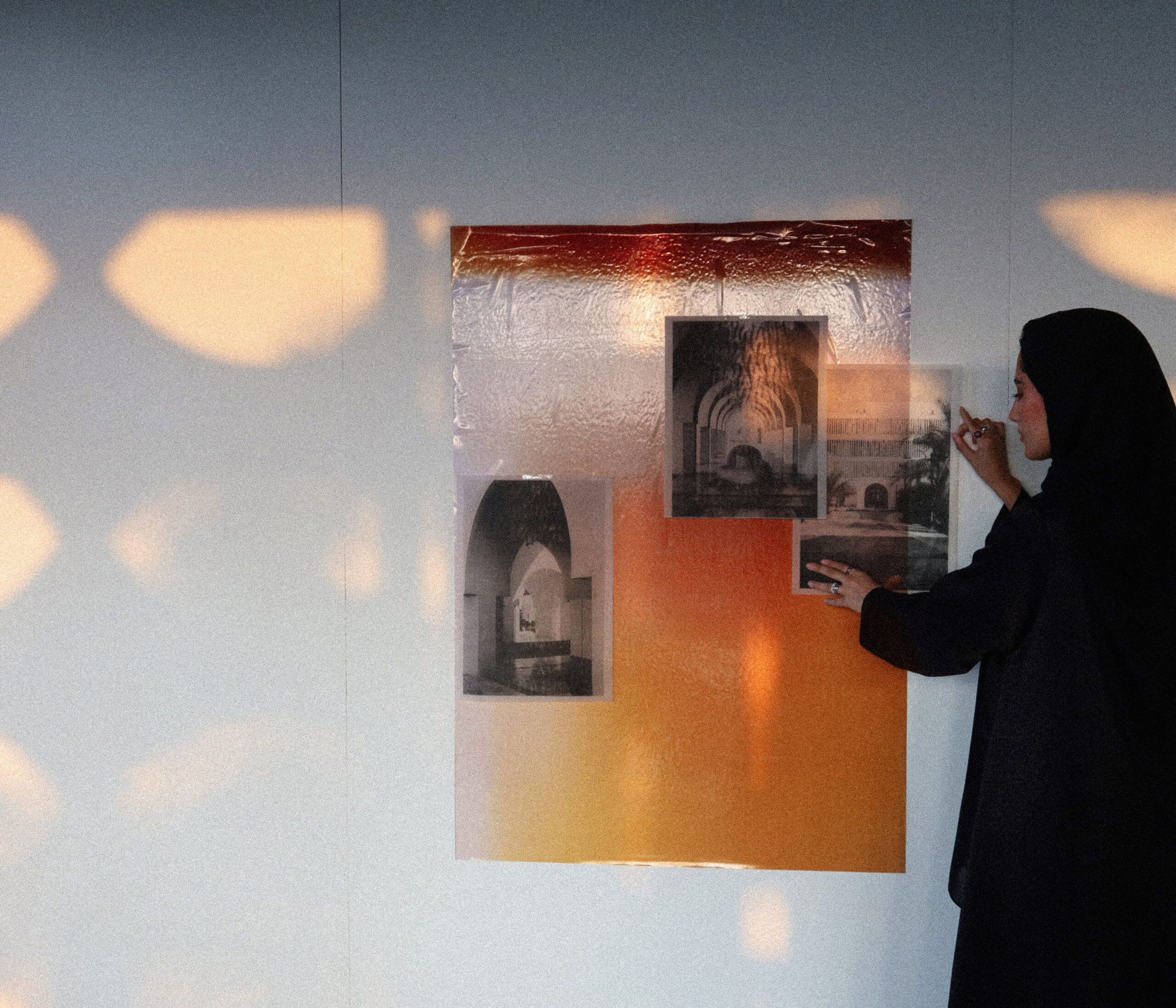
Qatari artist Noora Al Hardan (b. 1999) speaks to bayn/space about photographing Doha’s abandoned and soon-to-be-demolished spaces, the objects and traces left behind that make them feel anything but empty, and what she calls the ‘presence of absence’. Moving between painting, printmaking, photography, and installation, she lets analog imperfections— light leaks, overexposure, colour shifts—stand in for the way memory itself is fragmented and unreliable, turning documentation into a way of keeping a place alive after it is gone.

You studied painting and printmaking at VCU Qatar. Could you tell us more about your decision to pursue a career in fine arts?
Noora Al Hardan: I have always been drawn to art, especially painting, so studying fine arts felt like a very natural direction for me. When I first started at VCUarts Qatar, I was very focused on painting and honestly thought that was what I would stick to. But during my time there, I was introduced to so many different artists and mentors from around the world, and that really opened my eyes to how many ways there are to make art.
I slowly started wanting to move away from only painting and try other things like printmaking, photography, installation, and different ways of working with space. I think that process made me realise that I do not really like limiting myself to one medium. I like experimenting and letting the idea decide what form the work should take.
Your practice spans painting, printmaking, photography, and installation. How do these different mediums speak to each other in your work, and is there one that you always return to first?
Noora Al Hardan: My artistic practice started with painting, and at first my work was quite realistic and straightforward. Over time, mentors and professors encouraged me to experiment with other mediums, which naturally led me to photography, printmaking, and installation.
For me, all of these mediums are connected and often build on each other. I might photograph a space or a small detail that catches my attention, then take certain colours, textures, patterns, or shapes from that image and bring them into a painting or print. Sometimes those same elements develop further into an installation or projection, so the work keeps changing as it moves from one medium to another. I do not really see them as separate; they are different ways of exploring the same memory, place, or feeling.
Photography is often where an idea begins because it allows me to document a place as I experience it, but painting is still at the core of my practice. It’s the medium I feel most connected to and the one I always find myself returning to.

You have noted previously that photography plays a hugely important role in your work. Could you tell us more about the importance of photography in your practice?
Noora Al Hardan: I consider photography to be at the core of my artistic practice. A lot of my work starts from photographs I take of spaces around Qatar. For me, photography is a way of archiving these places and preserving not only how they look, but also the memories, feelings, and personal experiences I connect to them.
It also allows me to document places or details that might otherwise be overlooked or eventually disappear. I can then go back to these photographs and reinterpret them through painting, printmaking, or installation. So photography becomes both a way of documenting a space and a way of holding onto my relationship with it.

Light leaks, distortions, and filters are central to your photographic language. What draws you to imperfection as a way of seeing?
Noora Al Hardan: My love for analog photography started when I was really young. I remember my mother always using an analog camera to take photos of my siblings and me, and one of my favorite parts was waiting for the film to be developed. I would get so excited to see the printed photographs and help put them into our family albums.
As I got older, I kind of forgot about that connection until I took a darkroom photography class at university. We had to use analog cameras and develop our own film, and that brought all of those memories back while also making me appreciate the medium in a completely different way.
I became really drawn to the unpredictability of analog photography—the light leaks, overexposed areas, colour shifts, and unexpected marks. I liked how these imperfections could change an ordinary image and make it feel more emotional or personal. That also connected naturally to the way I think about memory, because memories are never completely clear. Eventually, I started bringing those qualities into my paintings through color, layering, and abstraction. So instead of seeing these imperfections as mistakes, I started seeing them as part of the visual language of my work.

Your work explores the intersections of place, memory, and perception. How has your work evolved thematically over the years?
Noora Al Hardan: My work has changed a lot over the years, especially in the way I think about place and memory. When I first started making work, I was mainly documenting everyday things around me—my car, roads, and scenes from daily life. At that point, I was mostly interested in capturing what I saw and keeping a record of those moments.
As my practice developed, I became much more drawn to abandoned spaces in Doha, or places that were being demolished or renovated. I started feeling this need to photograph them before they disappeared, almost as a way of preserving them and keeping some part of them alive.
Over time, it became less about simply documenting a place and more about how I remember it, how it felt to be there, and how memory can change the way we see things. Analog photography also became important in that process because the light leaks, overexposed areas, and imperfections reminded me of how memory works—it can be fragmented, unclear, and constantly changing.
So I think my work has gradually shifted from simply recording physical spaces to exploring the emotional connection we have with them, and how memory and perception can completely change the way a place exists in our minds.

Featuring local architecture, abandoned spaces, and sites slated for demolition play an important role in your work. Could you tell us more about your interest in these? Also, how do you find these places and what draws you to a particular space over another?
Noora Al Hardan: Preserving these places before they are demolished or renovated is really important to me. Through my work, I am able to keep a small part of their memory alive and appreciate the role they’ve played in our lives and in the collective memory of the city.
I usually find these places while driving around Doha, and sometimes friends will come across somewhere interesting and send it to me. What draws me to one space over another is usually the small details—the objects left behind, certain architectural features, textures, patterns, or anything that gives me a sense of the people who once used the space. Those traces are usually what make me want to spend more time there and document it.
What do you think is the relationship between abandoned spaces and our (daily) human experiences?
Noora Al Hardan: To me, abandoned places might be empty, but they never really feel completely empty. You can still sense the presence of the people who were once there through the objects, details, and traces they left behind. A lot of these spaces were once part of someone’s everyday life, so even after they’re abandoned, there’s still something very human about them.
I think that is what makes them interesting to me. You start imagining how the space was used, who lived or worked there, and what kind of routines took place there. Even something as simple as an old chair, a curtain, or a mark on the wall can make the space feel very personal. I also somehow find comfort in these places because they feel quiet and familiar, even when I’ve never been there before.

The overlooked and the ordinary appear again and again in your work. A disregarded blanket, a junkyard, a forgotten corner. What do you think it is about these mundane objects and spaces that hold such resonance?
Noora Al Hardan: For instance, the abandoned blanket connects strongly to my childhood memories. It was always around—whether I was sitting on the couch at home, during car rides in the winter, going to the desert with my family, or traveling by car to another country, which we did quite often growing up. Finding a similar blanket in an abandoned space suddenly brought all of those familiar and comforting memories back to me.
I think that is what draws me to ordinary objects and overlooked spaces. Something that might seem insignificant to someone else can hold so much memory and emotion. Once I connect it to a personal experience, it stops feeling ordinary and starts to carry a much deeper meaning. I like that these small details can quietly bring the past into the present.
Is your interest in the abandoned spaces related to the rapid changes Qatar has gone through in the past few decades?
Noora Al Hardan: Yes, I find change quite difficult, especially when it comes to old buildings or spaces that I grew up seeing. When they are altered or demolished, there is a sense of loss for me because they are connected to certain memories and periods of my life. I think that is why documenting these places comes so naturally to me. It becomes a way of preserving a part of them and allowing them to continue existing through my work.

You have spoken about the idea of the ‘presence of absence’. Could you tell us more about what that means for you, and how do you make something visible out of what is no longer there?
Noora Al Hardan: For me, ‘presence of absence’ is the idea that even when a person, place, or moment is gone, you can still feel that it was once there. An abandoned space might be empty, but it still carries small traces and memories of the people who used to be there.
I explore that in my work by photographing these spaces before they change, focusing on objects or details that have been left behind, and using things like light, shadows, empty areas, and fragments to suggest what is no longer there. I also take certain features, patterns, or architectural details from the places I visit and bring them into my artwork. In that way, a part of the place continues to exist through the work rather than being completely forgotten.
You blend analogue and digital approaches: traditional painting alongside photographic installation, for example. Is this tension between old and new something you consciously orchestrate, or does it emerge more intuitively?
Noora Al Hardan: My analogue practice usually starts with taking photographs on film, and I think what I love most about it is that I never have complete control over the final image. There are always unexpected light leaks, color shifts, or imperfections that give the photograph its own character. From there, I often bring those images into more digital forms through projection mapping or video installations.
The mix of old and new happens quite naturally for me. I like taking something very physical and unpredictable, like film, and then using digital tools to stretch it, move it, enlarge it, or completely change the way it is experienced. It almost gives the image a second life. I think having both approaches also gives me more freedom to experiment and lets the work develop in ways I might not have expected at the start. Sometimes the final result becomes something completely different from what I imagined when I first took the photograph.

You are currently a resident at the Fire Station. How has the experience been so far?
Noora Al Hardan: This programme feels very different from my previous residency experience. It’s the new Artists Intensive Study Programme at the Fire Station, and what I really enjoy about it is that it feels like I’m constantly being introduced to new ways of thinking. We have mentors and visiting artists from different parts of the world who give lectures, classes, and critiques, so there’s always a new perspective being brought into the studio.
I think the biggest impact has been how much it has challenged me to look at my own practice differently. Sometimes a conversation or critique can completely shift the way I see a work I have been making for months. I have also met artists from very different backgrounds and practices, and being around that kind of variety has made me more curious, more experimental, and more open to trying things I probably would not have considered before.
You might also like:
On Reconstructing Landscapes: Mubarak Al Thani
Reply