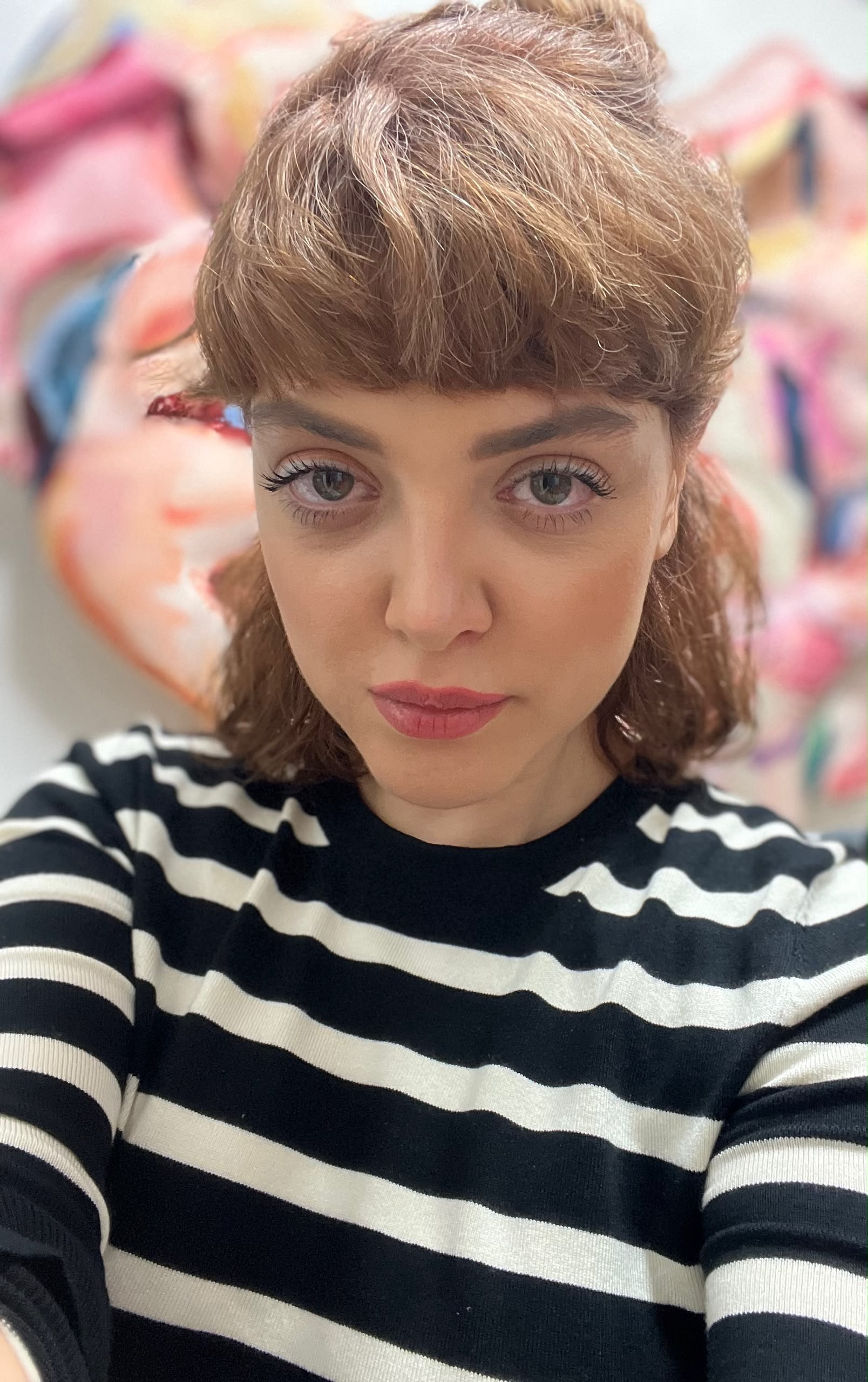
Iranian painter Zahra Shahcheraghi speaks to bayn/space about the female body as a site of conflict rather than provocation, a practice shaped by childhood memories of Safavid-era bathhouses, and a habit of painting out the very details her figures reveal. Working between figuration and abstraction, she draws private, often-hidden aspects of womanhood into full view before erasing them in paint—a gesture rooted in growing up under censorship. Her current series, made through the war in Iran, turns to women’s capacity to rebuild in the midst of destruction.

You have a BA from Elmi Karbordi University. Could you tell us more about your path of becoming an artist? Was pursuing a career in the visual arts an obvious choice for you?
Zahra Shahcheraghi: Honestly, I have never really been a student who studied diligently, and my path into art was not academic at all.
Acting was my initial choice, but over time I changed my mind and developed a serious interest in painting.
University education provided me with an educational path, but I never had the opportunity to find my personal language in painting or to shape my professional path as a painter.
A real turning point for me was when I began to paint alongside a painter of a previous generation. She did not merely teach me painting techniques; rather, she accompanied and guided me in discovering my interests and concerns in painting. This companionship allowed me to pursue my interests and gradually find my own personal language.
Your work draws inspiration from the imaginations and curiosities of your childhood. In what ways is your childhood present in your practice?
Zahra Shahcheraghi: My fascination with the strange and beautiful body of a woman began in the early years when my paintings were taking shape. This curiosity led me to go back into my past, even to memories from when I was five or six years old.
As a child, I would go with my grandmother, who was a traditional woman, to old Iranian bathhouses. These bathhouses, with Safavid-era architecture, were beautiful, dark, and mysterious spaces for me as a child. The image of women standing in line wearing chadors, waiting to enter the public or private bath, and then, after entering, setting aside their clothes, was a strange contrast for me.
Later, when I returned to these memories, I realised that part of my sexual curiosity and the questions I had about women may have begun from those experiences and that same contrast.
But gradually, these memories became only a starting point, and my work moved toward the subjects, experiences, and challenges that I encountered in relation to women, as well as the things that happen to women in my beautiful country, Iran.

At the same time you attempt to portray the concealed layers of the private sphere through the experience of womanhood. How has your work evolved in the past years in relation to this theme?
Zahra Shahcheraghi: I still do not see my work as truly evolved in the literal sense. I still have so many images in my mind that I am eager to bring to life, and I am still experiencing and exploring this journey.
I have always designed my works first and then used paint to remove the private parts of the figures, sometimes by whitening them out. I think this was not simply a visual choice, but something connected to my experience of growing up with censorship. I have repeatedly ignored issues related to my body and my sexual curiosities—things that are usually not easy to talk about openly. In my paintings, I first draw those very things and then hide them with paint.
My paintings themselves have given me the courage to talk about things that, in my culture, have always been accompanied by shame when spoken about. I think that the change in the story is less about arriving at a specific outcome and more about the process of getting closer to things I have kept hidden for years. For now, this is a path that is still unfolding.

The female figure is at the centre of your practice. Why do you find it important to portray women?
Zahra Shahcheraghi: It is not simply women themselves that interest me; more than that, it is the female body. From the time I became aware of myself, I grew up with definitions that existed within the social and historical context of my teenage years—that a ‘good girl’ was someone who wore a chador and covered her body. I, however, grew up free and open, with the freedom to choose whether or not to wear the hijab, and because of that, I was always in conflict with this way of thinking and with these social restrictions.
Outside the home, everyone seemed concerned with women’s bodies, women’s hair, and how much of their bodies they covered. Why should the female body be such a problem? What is there in this body that it must always be covered so that men will not become sexually aroused?
Perhaps one of the reasons I depict the female body in this way in my paintings is this desire to confront that way of looking. I want to place the female body directly before those who see it as a reason to restrict women and who set boundaries and rules for women’s presence in society and in different spaces.
My works are not erotic, and they do not even aim to be sexually provocative. On the contrary, I want to raise the question: if the female body is not inherently the problem, then where is the problem? Perhaps the problem lies in a way of looking that always sees the female body through a sexual lens.

Many of your paintings maintain a fluid, sensual and almost erotic dimension? What are your thoughts? To what extent is this intentional?
Zahra Shahcheraghi: I do not believe that my works are sexually provocative. In the beginning, when I started the series, the figures were more important to me and were placed in a fluid, undefined space where it was impossible to tell exactly where they were.
But gradually, the setting and location became important to me as well. Now, you can begin to guess where the figures are—whether in a natural landscape or a house. In my earlier works, the figures spoke more, but now the setting they are placed in has its own meaning for me and is connected to the statement of each series.
Could you tell us more about the blend of abstraction and figurative elements in your practice?
Zahra Shahcheraghi: Painting with abstract elements gives me pleasure in the act of painting itself. For me, abstraction is a way of expressing things that I cannot express through a figure within a defined space. By ‘cannot’ I do not mean an inability; rather, sometimes the figure and a defined space can become a barrier between me and the pleasure of painting.

What are you working on at the moment?
Zahra Shahcheraghi: Yes, at the moment I am working on a new project that I can say I love more than all my previous works.
Unfortunately, we Iranians are not in a good situation. The war between other governments and the current government of my country is happening and continues, and as always, it is the people who are suffering the most.
I have been working on this series since the beginning of this war. It was a very new experience. Bombs and missiles were passing over my studio, and I was painting in my studio, because painting is my only refuge.
The subject of this series, like many of my previous paintings, is again women; but this time it is more about their power to build. About women who, even when there is not even a place left to live, start again and rebuild life.
I think for me, this series is about this very power of building in the midst of destruction.

What are your hopes for the future in relation to your artistic practice?
Zahra Shahcheraghi: I am very hopeful and see a bright future for myself in the visual arts. I hope to continue growing in my artistic journey, develop my own personal artistic language more deeply, create more works, and build stronger connections with the global visual arts community and audience.

More on Zahra Shahcheraghi here and here.
You might also like:
Maha AbuMailesh: Between the Earth and the Body
Reply